




.png?width=512&height=512&name=FlowFit_Flavicon%20(1).png)







Software localization should be straightforward. Developers write code, technical writers refine the source text, linguists translate it, in-country reviewers verify it, and the product ships in every target language. The process looks clean on paper.
In practice, it rarely works that way.
Context gets lost between handoffs, translators guess at meaning. For in-country reviewers, it takes them quite some time to review the translations for new features and report issues found. And developers get pulled into an endless loop of localization queries.
The result is slower releases, more rework, and costs that compound quietly across the organization.
That gap between theory and reality is exactly where Rigi fits in. It connects product teams and localization teams around a shared visual source of truth so that everyone sees the same thing, at every stage of the process.
Software localization looks simple on paper
Most development organizations follow a recognizable localization workflow.
-
New features produce new UI strings
-
A technical writer edits the source text to ensure it matches the right style and terminology
-
Translators convert the source into every target language
-
In-country reviewers then verify the translations inside the real application
-
Their feedback loops back to the translators before release
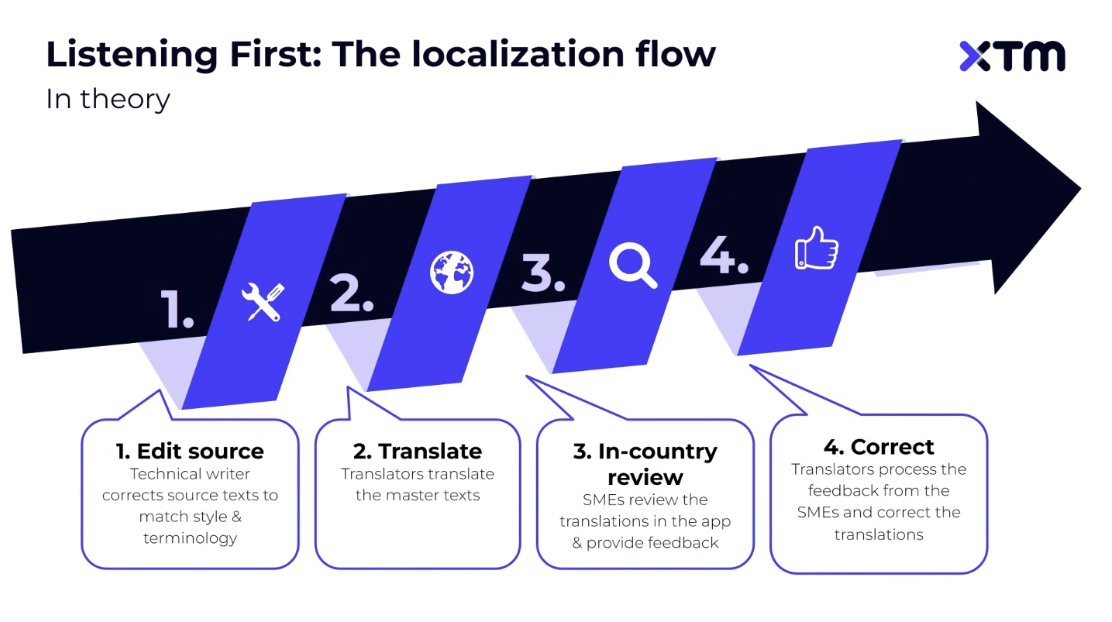
The roles are clearly defined. The feedback appears contained. Every handoff looks smooth.
But this view assumes that context is always available, that issues are resolved within the flow, and that all of these handoffs happen without friction. In reality, every one of those assumptions breaks down.
What actually happens between the handoffs
The real localization process involves constant back-and-forth between roles. And the single biggest driver of that friction is a lack of visual context.
Consider the technical writer:
-
They need to understand exactly where a string appears in the application before editing it. If they change the source text, that change cascades into every target language.
-
For a product localized in 40 or 50 languages, one incorrect edit creates a ripple effect across hundreds or thousands of strings.
-
When context isn't clear, the technical writer goes back to the development team and asks where the string is used.
On average, it takes about 45 minutes for a development organization to answer that kind of question.
Because the request passes through multiple layers before it reaches someone who knows the answer.
"Software application" - an example of a translation gone wrong
A real example: the word 'application' in an HR software product. Does it mean software application or job application?
One enterprise company discovered that their German translators had translated it as 'software application' across 300 instances.
In an HR product, that's a critical error. A corrective action for German and all other languages was imposed by senior management, consuming significant developer time and slowing the entire product roadmap.
Where are the bottlenecks?
In-country reviewers have their own friction. They need the application loaded with the latest translations, access to every relevant screen, and navigational instructions telling them where to click.
Developers have to build and maintain staging environments and write lengthy instruction documents just to enable the review process.
When reviewers find issues, they typically log them in a spreadsheet. They describe the problem, paste a screenshot, and suggest a correction. Those spreadsheets can run to hundreds of entries per language. When the translator receives one, they have to locate each string in their editor.
For common words that appear hundreds of times, there's no easy way to know which instance to fix without developer help.
The hidden cost lands on engineering and the business
Each of these friction points looks like a localization problem. Technical writers need context. Translators are guessing. Reviewers can't navigate the application. Developers are writing instructions instead of building features.
But when you step back, the pattern is clear. The work is fragmented, context is missing, and information doesn't flow cleanly between product and localization. This isn't a collection of isolated issues. It's a systemic problem. And it affects every level of the organization differently.
Practitioners feel it as daily friction
Developers want to automate repetitive tasks. Technical writers need consistency. In-country reviewers treat localization review as a side job because they're typically subject matter experts in sales, marketing, or other departments. Everyone is working around the same gap, but nobody owns the full picture.
Localization managers see the pattern
They notice that developers spend significant unplanned time supporting localization. Sprint capacity gets absorbed by ad hoc context queries that never appear in planning.
Engineering directors start tracking how much time their teams lose to localization support, and the numbers are consistently higher than expected. The question shifts from "what's slow?" to "is this a one-off mistake or a process failure?"
C-level sees the business risk
They care about time to market, brand exposure, and the cost of delayed international releases. An enterprise localizing 150,000 source strings into 40+ languages can't afford a systemic breakdown in quality.
For one Fortune 500 technology company, engineering teams handled approximately 12,000 localization queries per year, each taking an average of 45 minutes to resolve. That's over 9,000 hours of capacity absorbed by localization support annually.
Why the real problem isn't translation quality
At this point, the root cause becomes visible. The problem isn't poor translation quality. It isn't a tooling gap. It's a lack of visibility and alignment across teams.
Product teams work in their Git environments. Localization teams work in their translation management system. Neither side has a reliable way to see what the other is looking at.
| Role | What they see today | What they actually need |
|---|---|---|
| Developers | Code and resource files. No view of how translations render in the UI. | A way to hand off context automatically, without fielding queries. |
| Technical writers | Isolated strings in a list. No visibility into where text appears on screen. | UI context before editing source text, including layout and length constraints. |
| Translators | Source text without visual reference. Guessing at meaning, tone, and space. | A live preview of how their translation will render in the real application. |
| In-country reviewers | Static screenshots that go stale as soon as the interface changes. | Interactive, navigable previews they can review without staging access. |
Rigi closes this gap. It integrates with CI/CD pipelines on the product side and connects to translation management systems like XTM Cloud on the localization side. It captures HTML previews of the live application and associates them automatically with the corresponding strings.
The result is a shared source of truth. Every role listed above gets exactly what they need, without depending on developers to provide it.
This is the moment where the real value of Rigi clicks.
The problem was never about better translations or faster translators. It was about giving every person in the workflow the visual context they need to make the right decision the first time.
What changes with Rigi in place
Rigi is a visual context platform for software localization. It sits between your development environment and your translation management system, capturing HTML previews of your live application and linking them directly to the corresponding strings.
Every stakeholder, from technical writers to in-country reviewers, sees exactly how text appears in the real UI without needing access to staging environments or developer support.
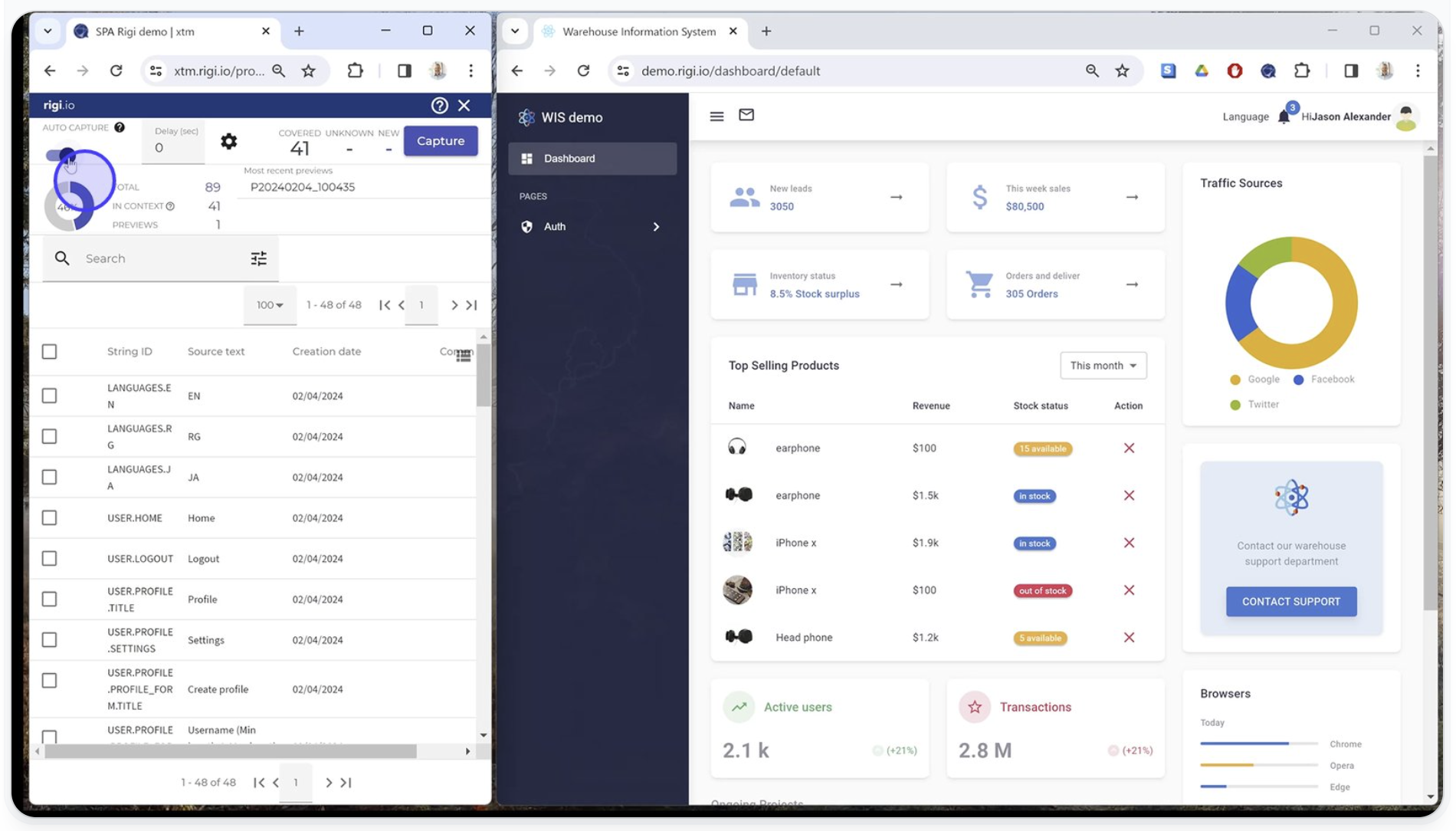
The result is that localization becomes fully decoupled from development.
No more context queries. No more navigational instructions. No more spreadsheet-based review cycles. Every role in the workflow operates independently, with full visual context, at every stage of the process.
Reduce context-related queries by up to 60%
Organizations using Rigi report measurable improvements across the localization workflow.
One global enterprise technology company:
- Shortened software localization turnaround time by 25%
- Reduced the number of context-related queries by 60%
- Saved up to 90% of developer time
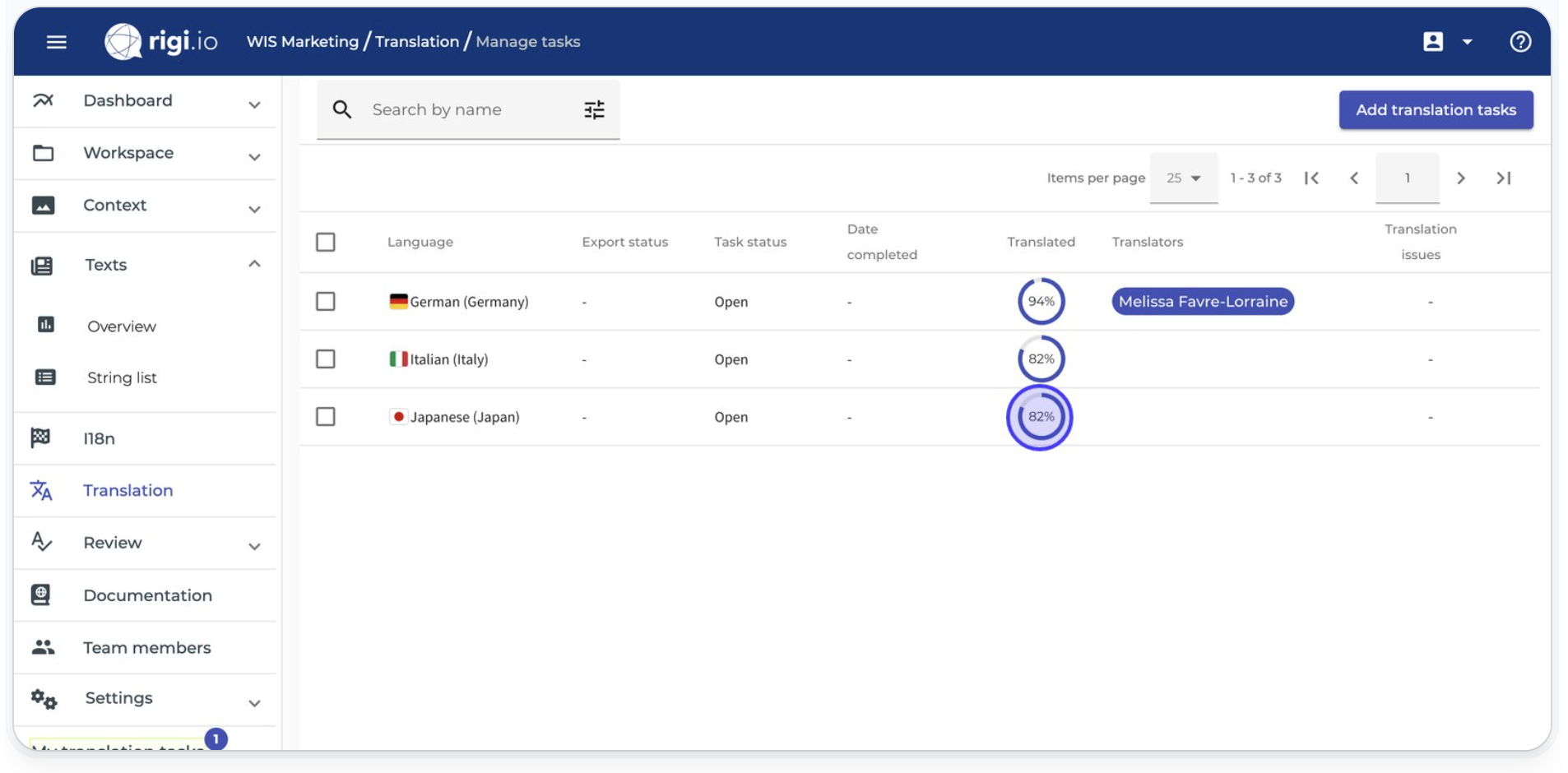
They no longer write navigational instructions, maintain staging environments for review, or field questions about where strings appear in the application. Rigi's automated preview capture handles it during the existing UI testing process.
Remove team friction around localization
Beyond the efficiency gains, teams report something harder to quantify but equally important: better collaboration between development and localization.
These groups have historically operated with tension. Developers feel burdened by constant questions. Localization teams feel unsupported by a lack of information. Rigi removes the friction that causes that dynamic by making context visible to everyone, automatically.
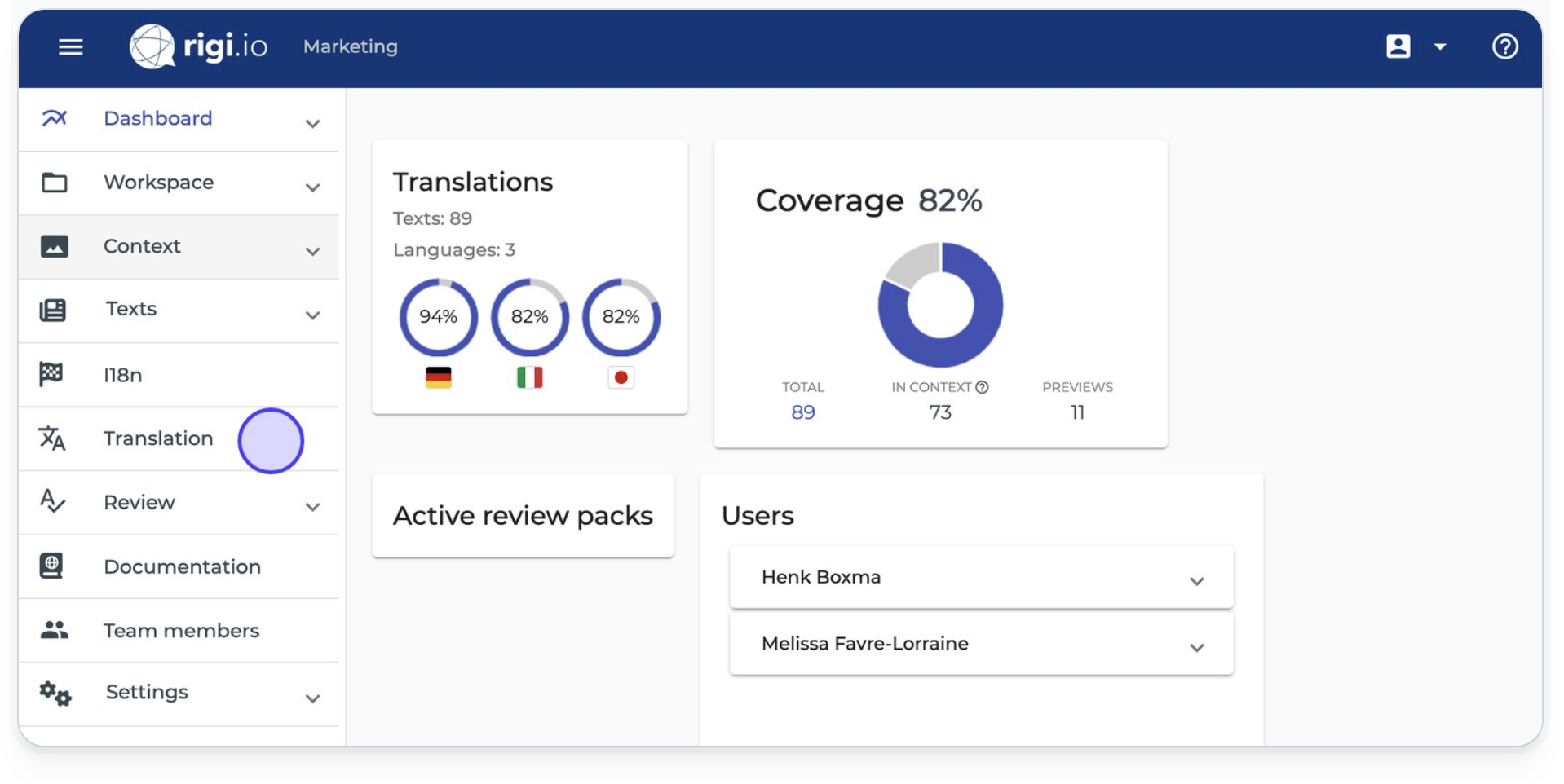
Teams also find that once Rigi is in place for its primary use case, it expands naturally. One customer began using Video Creation Cloud in combination with Rigi to generate multilingual instruction videos from one source.
From evaluation to measurable business impact
Rigi isn't another tool layered on top of an already complex process. It's a workflow alignment layer that sits between product and localization, removing the back-and-forth that slows everything down.
We recommend positioning it around three outcomes that matter to both technical teams and business stakeholders.
- Workflow alignment: Rigi connects development and localization around a single visual source of truth, replacing fragmented communication with a shared view of the product.
- Risk reduction before release: With visual context available at every stage, issues are caught earlier when they're cheaper and faster to fix. Teams don't discover mistranslations after the product has shipped.
- Shared visibility: Everyone in the organization, from translators to C-level stakeholders, sees the same thing. This removes ambiguity and builds confidence in global releases.
Final thoughts
The strongest path to adoption starts with validating Rigi against a real workflow.
-
Use your own files, your own tools, and your own team structure
-
Involve both technical and localization stakeholders from the beginning
-
Define what success looks like in measurable terms: fewer queries, faster turnaround, reduced rework.
When the evaluation is grounded in your actual process, the conversation shifts from product evaluation to business impact. And that's where Rigi stops feeling optional and starts feeling obvious.
Want to see Rigi in action? Take our product tour and see easy it is to transform your localization process and get up to 90% of your time back.

Subscribe for More
Lorem ipsum dolor sit amet, consectetur adipiscing elit, sed do eiusmod tempor incididunt ut labore et dolore magna aliqua. Ut enim ad minim veniam, quis nostru.