












Reflections from Vancouver Localization Week 2026, spanning the TAUS Conference and LocWorld56: what was said, and what it means for enterprise localization.
Vancouver Localization Week brought two conferences to the same city: the TAUS Annual Conference and LocWorld56. Each had its own agenda and its own audience. Yet the message from both was remarkably close.
The localization industry is moving from disruption to structured adaptation. The question is no longer whether AI changes the work, but how enterprises organize around it.
With the week hosted in Canada, local voices played a central role. The Government of Canada’s Translation Bureau, First Nations language communities and students from local universities all took part, which gave the conversation a wider lens than technology alone.
Here are the themes that stood out, and what they mean for enterprise localization.
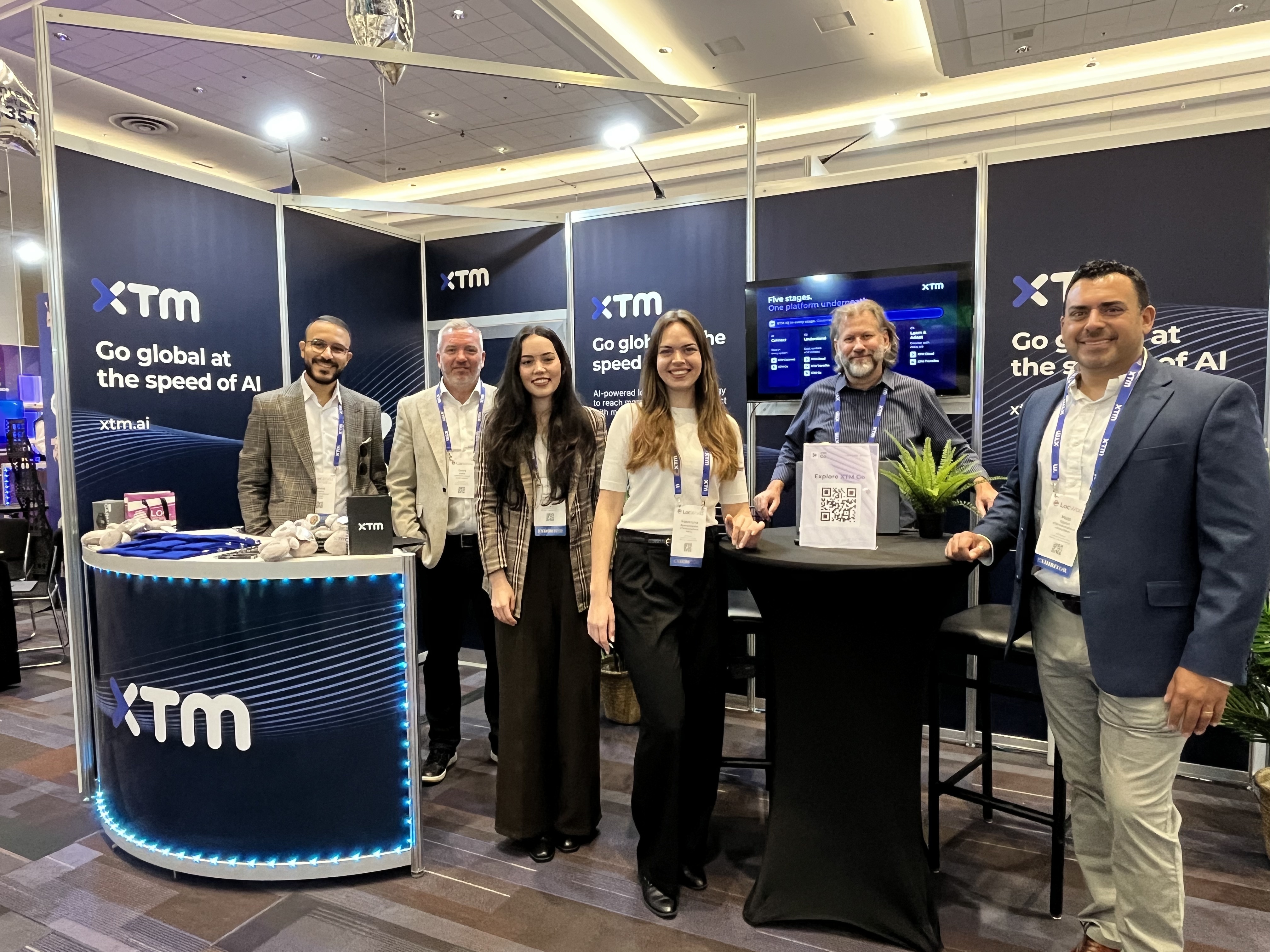
From cautious experiments to open orchestration
Across both conferences, the mood felt thoughtful rather than hurried. Many teams seem to be taking their time with AI, keeping a close eye on the market and exploring their options before settling on a long-term strategy.
For a lot of enterprise localization teams, that exploration is happening in-house. Building their own AI prototypes gives them a chance to see first-hand how the models handle their content, and where they still fall short.
Where prototypes run out of road
A prototype answers one question: can the model do this? Production asks many more. Where does content come from? Who checks it? How does it get back to the right system? What happens when a better model arrives next quarter?
Those questions were behind a second theme that ran through both conferences: the end of the rigid, fixed pipeline. Speakers described a shift toward open orchestration, where MT engines, translation management systems, AI translation grounded on your own language assets, and quality scoring all work as one connected system.
At the TAUS Conference, XTM CEO Lorcan Malone joined the panel From TMS to AI Orchestration to discuss exactly this shift.
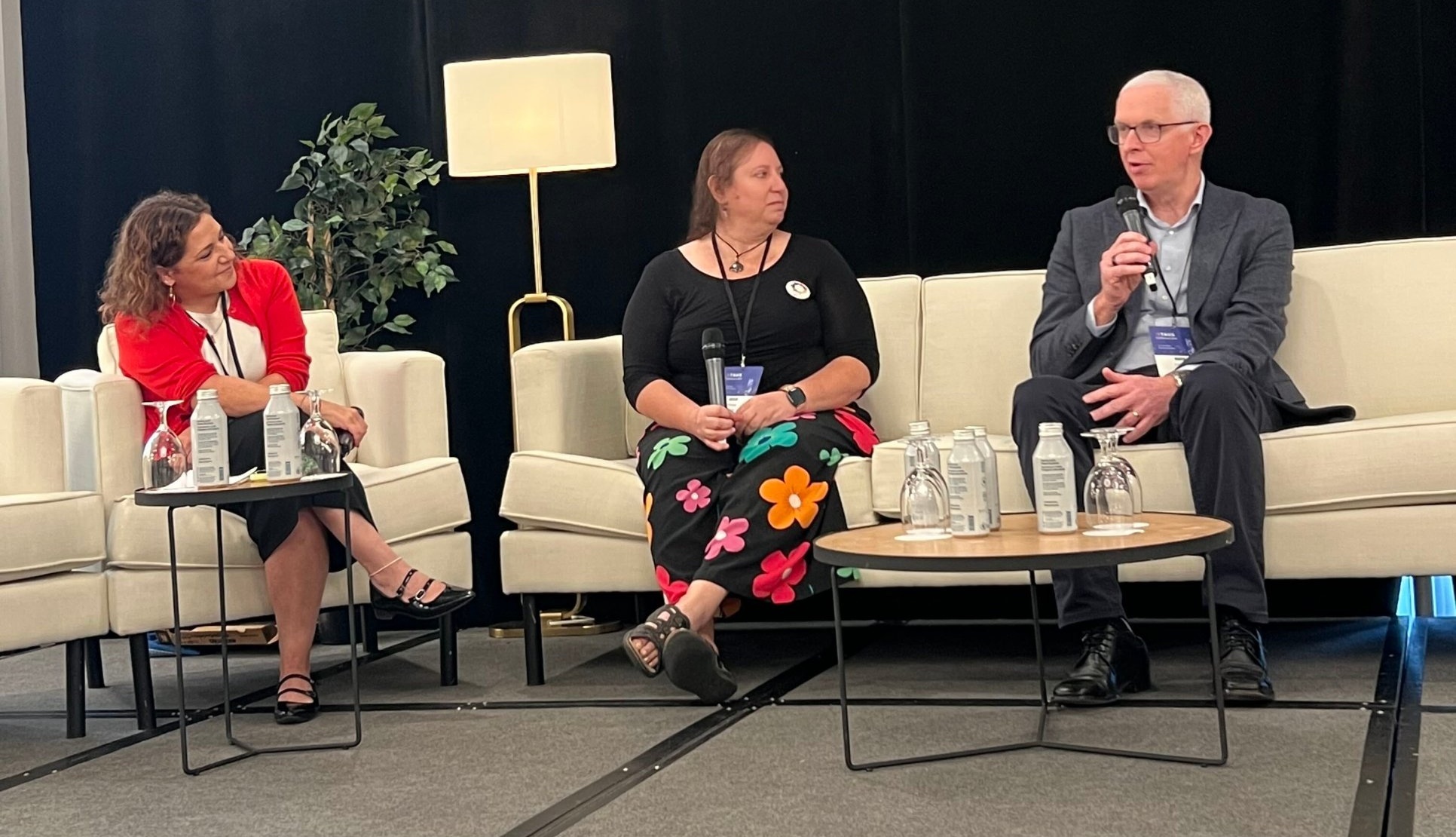
Connectivity first
The recurring point was that none of this holds together without connectivity. Tools need to exchange data and adapt as needs change, not sit in separate silos waiting for a manual export.
Governance is what makes scale possible
A public sector example worth copying
In the TAUS Conference, the Government of Canada's Translation Bureau gave one of the clearest pictures of AI adoption done responsibly. Its starting point was not the model. It was data sovereignty and governance.
The Bureau has trained models on domain-specific corpora: the specialised language of public administration. Around them, it has built governance frameworks that decide how those models are used. Its next steps are continuous retraining, speech recognition, and adoption across more departments.
Few organisations face a higher bar for accountability than a national government. That is exactly why the Bureau's approach travels well to the enterprise.
When agents start making decisions
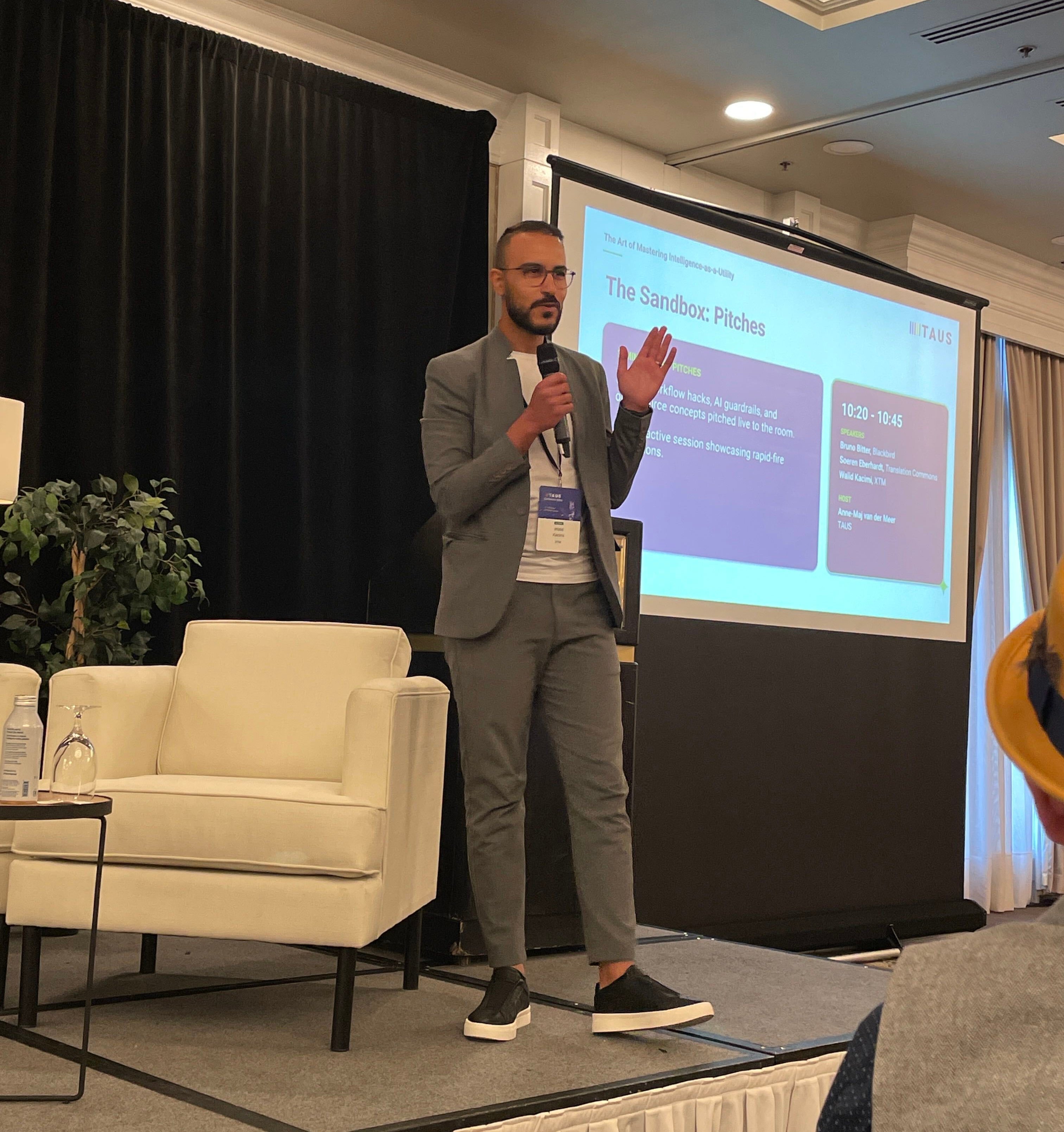
This was the focus of my own pitch at TAUS, as part of the Sandbox Pitch program: what mastering intelligence as a utility actually takes. My answer came down to three things: cross-system standards, AI governance and operational clarity.
Governance becomes even more important as AI takes on a bigger role. With multi-agent systems handling more of the localization process, agents start handing work to each other and making choices along the way.
That raises the need for traceability: a clear record of agent-to-agent interactions, decision chains and execution steps. Closed, proprietary black boxes make that impossible. Open architectures make it possible.
Beyond text: how AI is broadening translation
MT hasn't stood still
With so much attention on large language models, it is tempting to file machine translation (MT) under legacy. The discussions during the week offered a different view. MT models now learn faster, adapt in real time and keep training as new content arrives.
From text to voice
The scope of translation is also widening beyond the written word. Multimodal work, particularly text-to-speech (TTS), drew strong interest, and the Translation Bureau’s plans to integrate speech recognition show the same shift toward voice.
AI for language preservation
Alongside the discussions on technology and workflows, there was a strong focus on training AI models for low-resource and Indigenous languages, highlighting initiatives from First Nations communities in Canada and around the world.
The Translation Bureau and other global leaders also shared their vision for using AI to protect, revitalise and keep endangered languages and cultural heritage alive for future generations.
The changing value of language expertise
Linguists move upstream
The role of linguists is evolving rather than disappearing. Increasingly, their expertise comes into play earlier in the process, shaping the foundations that AI systems rely on.
Many linguists are moving from traditional translation and review into roles such as solution engineer and linguist engineer. This work includes crafting AI prompts, cleaning and preparing data, refining pipelines, and maintaining term bases, style guides and translation memory (TM), so AI systems are continuously fed with the right context.
Rethinking the word count
As the linguist’s role expands, so does the question of how to price it. The per-word metric is gradually giving way to models that better reflect pipeline engineering, data governance and strategic review.
Service providers and enterprise teams are exploring new productivity and pricing metrics, such as time-based or value-based models, that better capture this kind of work.
The next generation of talent
Fresh perspectives are also shaping where the industry goes next. At LocWorld56, PIC Sneaks! gave students from local universities the opportunity to share their early-stage ideas and prototypes, showing how emerging talent is developing inventive, real-world workflows.
Three things to take forward
-
From prototype to platform. In-house experiments are helping teams understand what AI can do. Open orchestration and clear governance are what turn those experiments into workflows that scale, and that can be traced.
-
MT keeps evolving. Machine translation is learning faster, adapting in real time and training continuously. Alongside it, multimodal developments in both text-to-text and text-to-speech are widening what translation can cover.
-
Expertise moves upstream, and pricing follows. Linguists are increasingly shaping the systems AI relies on, and new pricing models are emerging to reflect the value of that work.
Final thoughts
Vancouver Localization Week showed an industry that has moved past asking whether AI belongs in localization. The focus now is on how to make it work well, with the right systems, the right governance and the right people around it.
A big thank you to the TAUS and LocWorld organizers, all the speakers, and every attendee who joined us for the conversations and ideas that made the week so valuable. We’re already looking forward to the next one.

Subscribe for More
Lorem ipsum dolor sit amet, consectetur adipiscing elit, sed do eiusmod tempor incididunt ut labore et dolore magna aliqua. Ut enim ad minim veniam, quis nostru.