




.png?width=512&height=512&name=FlowFit_Flavicon%20(1).png)







Reflections from the sessions at XTM Live City Tour San Francisco 2026: what was said and what it means for enterprise localization
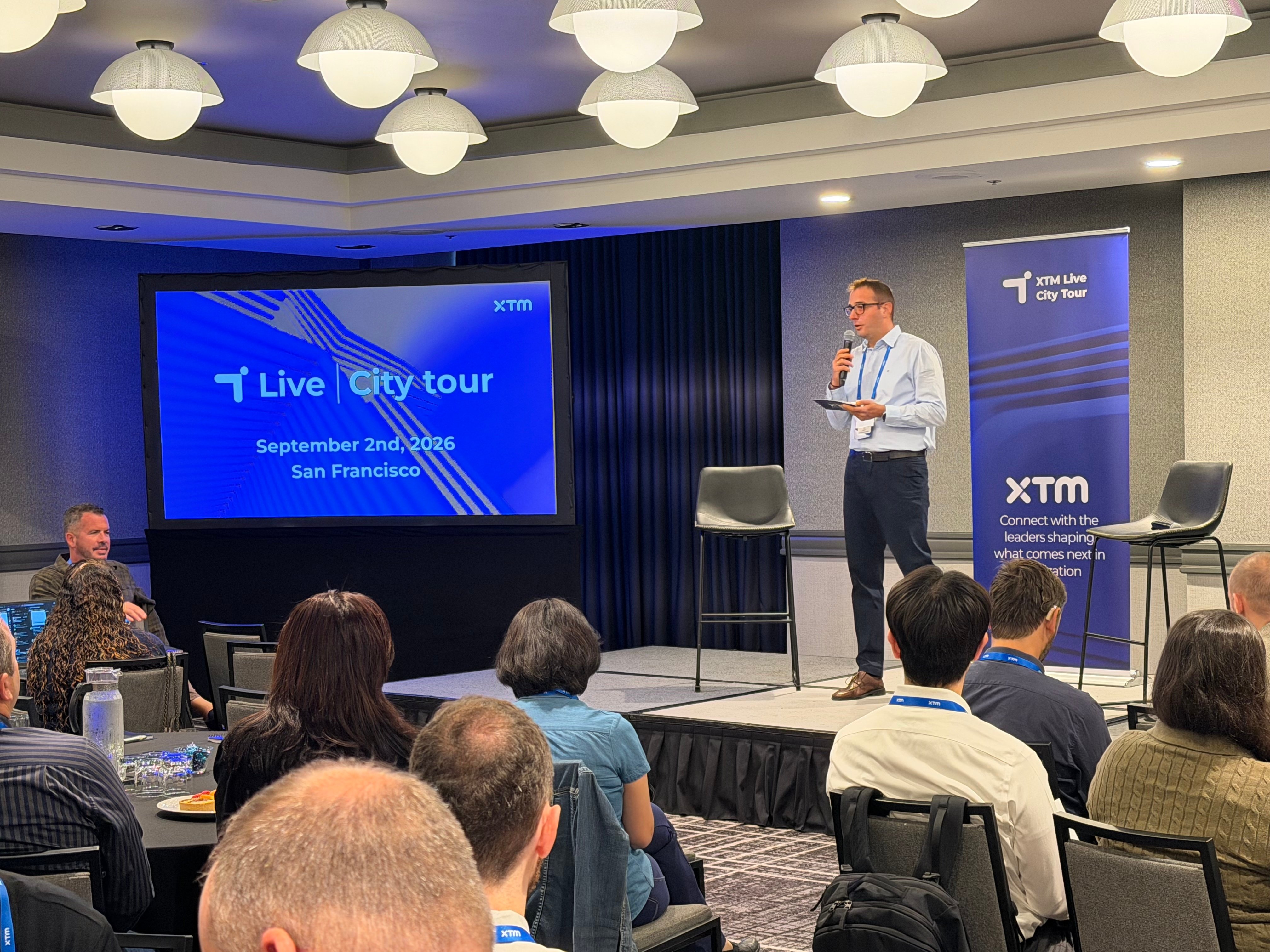
San Francisco was a deliberate stop on this year's City Tour. As XTM COO Alex Zekakis told the room, it's where change moves fastest, and the format stayed just as small as the previous stops: close enough that people actually talk to each other, rather than just listen.
His framing for the day was direct. We've gone from the summer of AI hype to the winter of reality. The question has stopped being if we're going to do something with AI, and become how. Rather than a comfortable conversation about legacy workflows and what's worked in the past, the day was framed as a chance to look ahead together. The value of adopting AI isn't really in question anymore. The real work now is figuring out how to put it into practice.
Here's what came out of the day, session by session, with the highlights worth taking forward.
1. The fireside chat: what thirty years in tech says about this AI moment
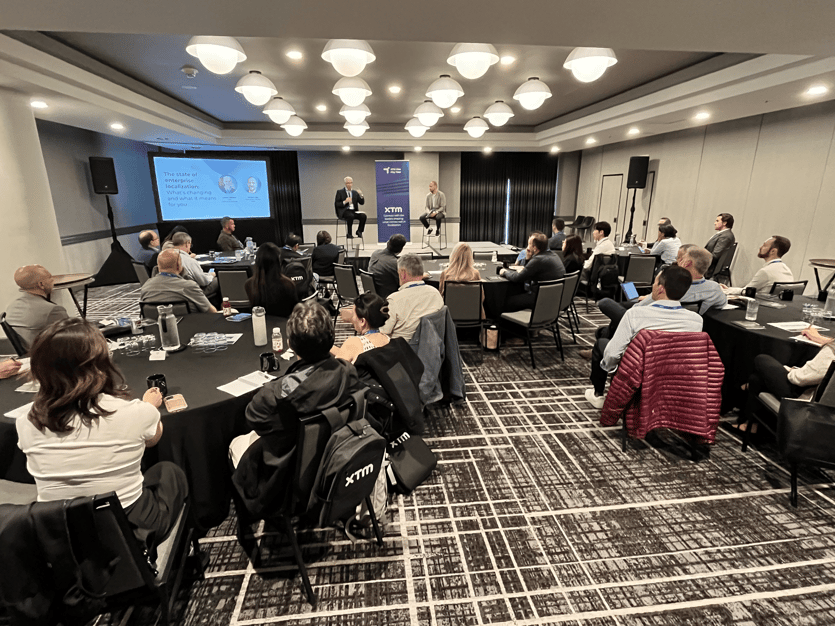
Lorcan Malone, CEO, XTM, in conversation with Florian Faes, Managing Director at Slator
Lorcan Malone has been in technology for thirty years, long enough to have lived through the dot-com boom in San Francisco itself. Asked how that moment compares to this one, his answer was simple: this one is bigger and faster, and while some companies may struggle to keep up, AI itself isn't going anywhere.
That framing carried through the rest of the conversation. AI doesn't retire the systems companies already use to manage translation, Malone argued, it changes what those systems are for. The work itself: connecting to content, running a workflow, checking quality, delivering the result, stays the same. What changes is that AI now does the heavy lifting inside that structure, rather than replacing it.
The value XTM adds beyond the model
He was equally direct about strategy.The XTM platform stays deliberately open to whichever model a customer wants to use, and puts its own effort into the things a model can't supply on its own: glossaries, style guides, the accumulated context of how a business actually talks. Malone also named something else he sees in the room: a constant, low-grade anxiety about keeping up, the sense that some new AI tool or term has appeared overnight and everyone else already knows about it. His view is that customers shouldn't have to chase that alone. Tracking which innovations are actually worth adopting, and filtering out the noise, is the job XTM has taken on for them.
A result worth noting
He also shared a concrete example. One large software customer cut its human review costs by 41% in the first month of a new rollout, rising to 50% within a quarter. They did this by being more precise about which content actually needed a person's review, rather than cutting people out of the process altogether.
"You have to connect to your content, orchestrate a workflow, do your translation and verification, deliver the content back. That job doesn't change. But all of it is going to be wrapped in AI... it's essentially a harness for your AI."
— Lorcan Malone, CEO, XTM International
WHAT IT MEANS The point is about what actually does the work. Translation platforms don't just plug people into an AI model and step back. They're still the ones deciding what needs translating, checking whether the result meets the expected quality standards, and making sure it reaches the right place. AI changes how the translation itself gets done, but someone (or something) still has to manage that whole process around it. That's what Malone means by "harness": the platform stays in charge of directing the AI, rather than the AI making the platform unnecessary.
2. Trust in AI: a customer panel on what “good enough” actually means
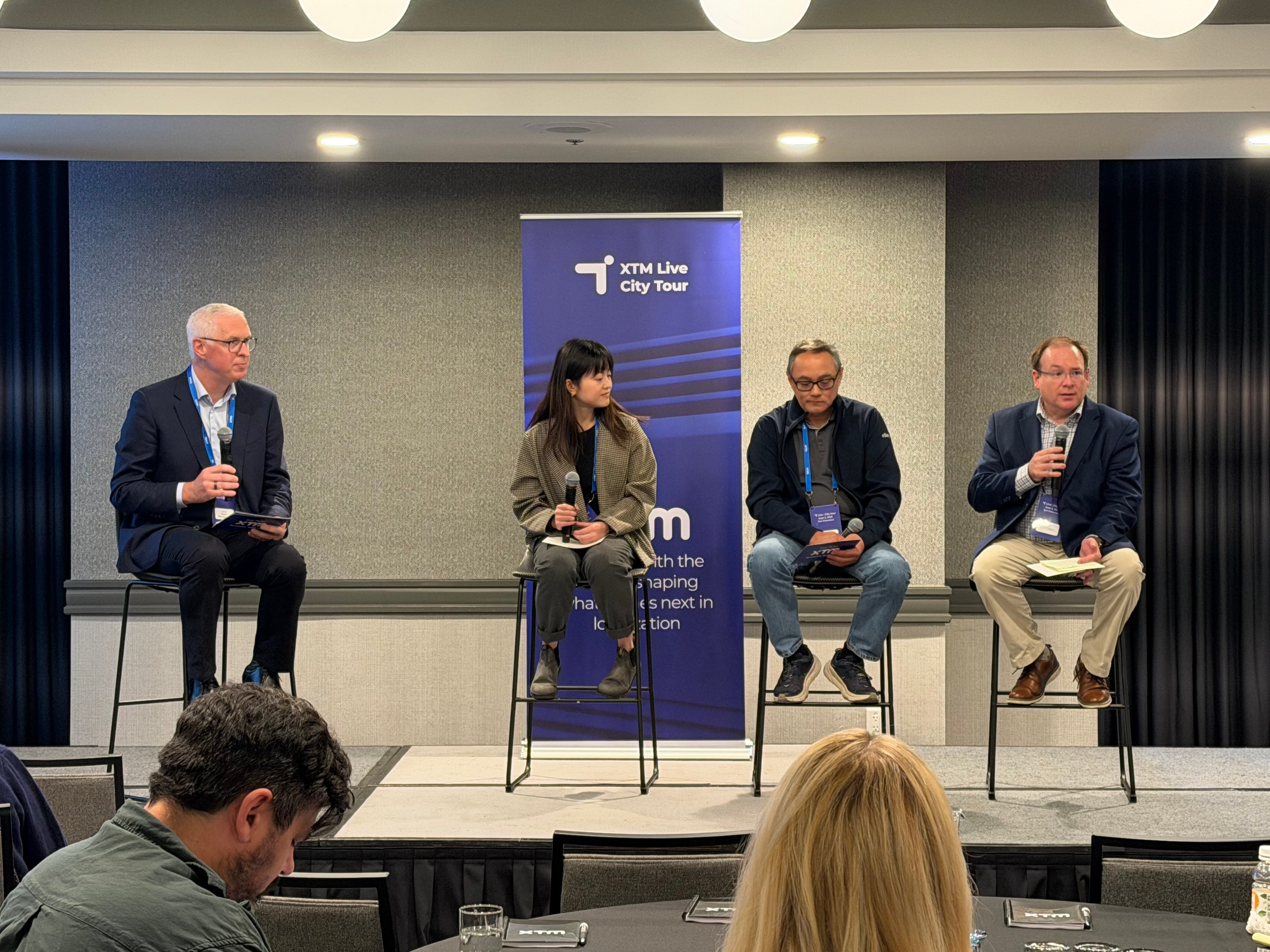
Greg Perkins (Church of Jesus Christ of Latter-day Saints), Marco Rotelli (eBay), and April Zhang (ICIMS)
Finding the real source of trust
Three customers, three very different kinds of content, one shared question: what actually makes AI-translated content trustworthy enough to publish? For Greg Perkins, whose team translates everything from app strings to scripture and hymns, the answer isn't the model itself. It's the whole system around it: the process, the governance, the people reviewing the work. That system earns trust by being scored against risk: a hymn a congregation will sing for generations gets far more scrutiny than a routine support-chat answer nobody will remember tomorrow.
The risk of scale: when one mistake becomes many
April Zhang, at ICIMS, pointed to a newer version of that same risk. When a human translator makes a mistake, it only affects one language. If the original English source is unclear or gets misread, AI can carry that same mistake into every translated language at once. That's why her team leans even harder on catching issues in the source itself, before translation even starts.
Built-in gatekeepers from day one
At eBay, Marco Rotelli's team built something similar to Perkins' idea of a trusted system, calling it "judges": models trained on eBay's own glossary and style guide that score translation quality and automatically pull anything touching legal or payments content out of the standard pipeline. Every output still goes through full human review for now. Linguists don't just fix what's wrong, they also log why the correction was needed, and that reasoning feeds back into improving the prompts and models over time. When marketing or product teams ask why they can't just use the translate button already built into their own tools, Rotelli's answer goes back to a lesson learned years earlier, back when the shortcut in question was Google Translate rather than AI.
"We couldn't stop them, and we didn't stop them. We said, go ahead, do it! Just don't come back to us when things go wrong. And things did go wrong. If somebody says I'm going to press the button, don't be the people in the middle trying to fix their problem. Make them take responsibility for their actions. They will learn straight away."
— Marco Rotelli, eBay
WHAT IT MEANS The point here is simple: people don't stop using an unofficial shortcut because they're told not to, they stop when they see it actually go wrong. eBay's team learned that trying to police the shortcut directly didn't work nearly as well as letting people feel the outcome for themselves, then being ready with a better option once they came looking for one.
Looking further out, all three speakers landed in the same place: less time producing translations by hand, more time setting the standards everything else has to meet. As Perkins put it, teams are shifting from being the people who do the work to being the people accountable for it. With the volume of content only growing, and localization teams generally staying small, this shift toward oversight may be the only realistic way to keep pace without needing to hire at the same rate that content is expanding.
3. Built to decide: a look inside the XTM platform
Maureen Wink, AI Value Engineer, XTM International
Maureen Wink's session picked up where the morning's risk conversation left off: content volume keeps growing, but the way most companies actually get it translated, at quality, on time, hasn't changed much in over a decade. Her answer is a single platform built on three layers: knowledge, intelligence, experience.
The three layers behind the platform
The knowledge layer holds translation memory, terminology, and everything a company already knows about how it wants to sound, all in one place instead of scattered across different tools.
The intelligence layer works like the brain: it looks at incoming content, decides which workflow it should follow, and estimates how good the result will be before a person ever sees it.
The experience layer is where people and other systems actually interact with the platform. Each role gets its own interface, built around what that person needs to do. Increasingly, other tools can also connect directly into XTM's capabilities, without anyone needing to log in separately at all.
Maureen shared one example of what that looks like in practice: a project manager working entirely inside Microsoft Teams got an automatic alert that a vendor was running three days behind, complete with a suggested fix, without ever leaving Teams or logging into a separate portal.
The system that makes the call
XTM Go is the tool built to make exactly that happen. It checks a document for risk, complexity, and intent the moment it arrives, then sends it down the right path: straight to AI if the content is low-risk, a mixed AI-and-human workflow for things like campaign assets, and full human review for anything sensitive or regulated. Behind that sits a central engine that keeps track of every AI model an organization uses, along with the account keys needed to access them. Instead of each tool managing its own connections separately, everything routes through this one system. That means decisions about which model handles a piece of content, and what it costs, are all visible in one place rather than scattered across different tools.
"When a piece of content needs to exist in 47 languages, from a UI string to a regulatory submission, what happens next? Today, a project manager decides, a template is applied, assumptions are made. We believe the right answer is that your platform knows: it has classified the content, selected the path, engaged the right resources, and your team is managing exceptions, not administration."
— Maureen Wink, AI Value Engineer, XTM International
WHAT IT MEANS The shift Maureen is describing is about who makes the call. Right now, in most companies, a person decides how a piece of content should be handled, usually based on habit or a quick guess. What she's describing instead is a system that looks at the content itself and makes that decision, bringing a person in only when something genuinely needs their judgment. That's true no matter where the content starts, the entry point changes, but the decision-making underneath stays the same.
4. Case in point: Adobe Express
Christopher Zhang, Product Manager for Extensibility & Ecosystem Partnerships and Alex Castanheira, Director of Platform Partnerships, Adobe
Alex Castanheira opened by pointing to something that had already come up earlier in the day: content volume is exploding, and the people creating it now go well beyond localization teams. Marketing, sales, and HR are all now expected to create content, and all of it needs to stay on-brand, across every market and format. Adobe Express, he explained, is built for exactly that: a lightweight, self-serve tool that lets anyone in an organization create polished content without needing deep design skills, pulling in Adobe's existing image and video editing tools alongside AI generation through Firefly.
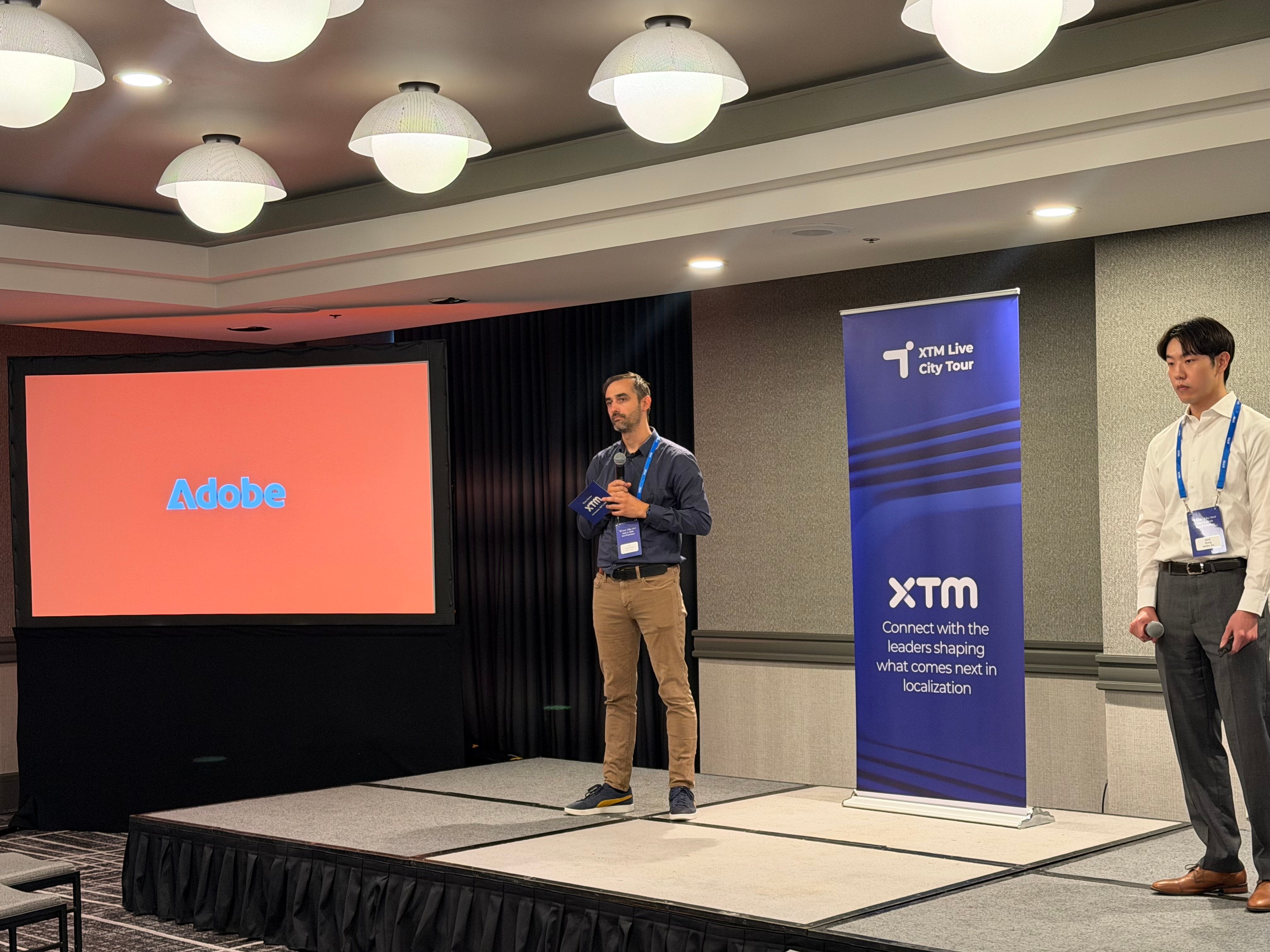
Adobe extends that same decision-making into tools that marketing, sales, and HR teams already use every day. Christopher Zhang and Alex Castanheira described a partnership that brings XTM directly into Adobe Express, so teams building on-brand content across different markets don't have to leave their usual workspace. Brand dictionaries and style guides apply automatically through the connector, and content gets checked for risk before it ever reaches XTM's system. Teams don't need to switch tools overnight, either: because Express can read text and image layers from Photoshop or InDesign files, people can start using translation right inside their existing design work. Designers still set the guardrails, like locking certain colors or letting text boxes resize, and someone still checks the final layout before anything goes live.
"We know you need your brand dictionaries, glossaries, and style guides as part of translation, so we built a connector that lets customers use XTM, the translation solution they already know and trust, right inside the creative workflow Adobe Express already offers."
— Christopher Zhang, Product Manager for Extensibility & Ecosystem Partnerships, Adobe
WHAT IT MEANS The choice Adobe made here is worth noticing: rather than asking teams to learn a new translation tool, or asking localization teams to give up the controls they'd already built in XTM, the connector just moves that same trusted system into a workspace people are already using. Nobody has to switch tools or rebuild their setup from scratch, which is often the real reason a good governance system goes unused in practice.
Three things to take forward
→ AI doesn't replace the TMS, it reframes it. Orchestration, routing, and delivery haven’t gone away. What's different is whether the system can keep pace as the AI behind it keeps evolving.
→ Trust is built, not switched on. The confidence to publish AI output comes from governance, review loops, and accountable people. It doesn’t come from any single model being good enough on its own.
→ The tasks evolve, the people remain. What kept coming up, from the fireside chat to the customer panel, was the same shift: less hands-on production, more time spent reviewing, training, and setting the standards everyone else follows.
Final thoughts
The afternoon moved into round tables, and the day closed with an unconference built entirely around topics the attendees raised themselves. A few things came up at nearly every table. Translation memory is still, as one participant put it, "gold", though it's evolving into a broader layer of context, pulling in things like metadata and mockups alongside the source text. Pricing is also shifting, slowly, from per-word rates toward hourly billing. And where AI has cut costs, that saving has mostly gone toward producing more content within the same budget, rather than spending less overall.
The ideas looking further ahead were even more interesting. A few tables talked about generating content in every target language at once, rather than translating from a single source. Others discussed workflows that adapt within a single document instead of following one fixed approach per document type. And several tables shared a real interest in knowledge graphs: a way of organizing information that could give AI systems more context to work with.
Worth noting: XTM Go was shown twice during the day, and it already won the Innovation Award at LocWorld Dublin earlier this year. So some of what's on the roadmap here has already been tested in the real world, not just talked about.
Thank you to our partners: Adobe, LanguageLine, Vistatec, Argos Multilingual, and Acclaro, for supporting the day, and to everyone who joined us in San Francisco, our third City Tour stop this year.

Subscribe for More
Lorem ipsum dolor sit amet, consectetur adipiscing elit, sed do eiusmod tempor incididunt ut labore et dolore magna aliqua. Ut enim ad minim veniam, quis nostru.