




.png?width=512&height=512&name=FlowFit_Flavicon%20(1).png)







Reflections from each session at XTM Live City Tour London 2026: what was said and what it means for enterprise localization
Three years ago, we were on a London stage talking about an “AI revolution” as something coming. In 2026, no one in our industry debates whether AI is happening. The room at XTM Live City Tour London was deliberately smaller than our 2023 event, intentionally so. We wanted localization leaders, customers, and partners close enough to have the kind of conversations the current moment demands.
Here's what came out of the day, session by session, with the highlights worth taking forward.
1. Keynote & Fireside: The state of enterprise localization - what's changing and what it means for you
Lorcan Malone, CEO, XTM International, with Florian Faes, Managing Director, Slator
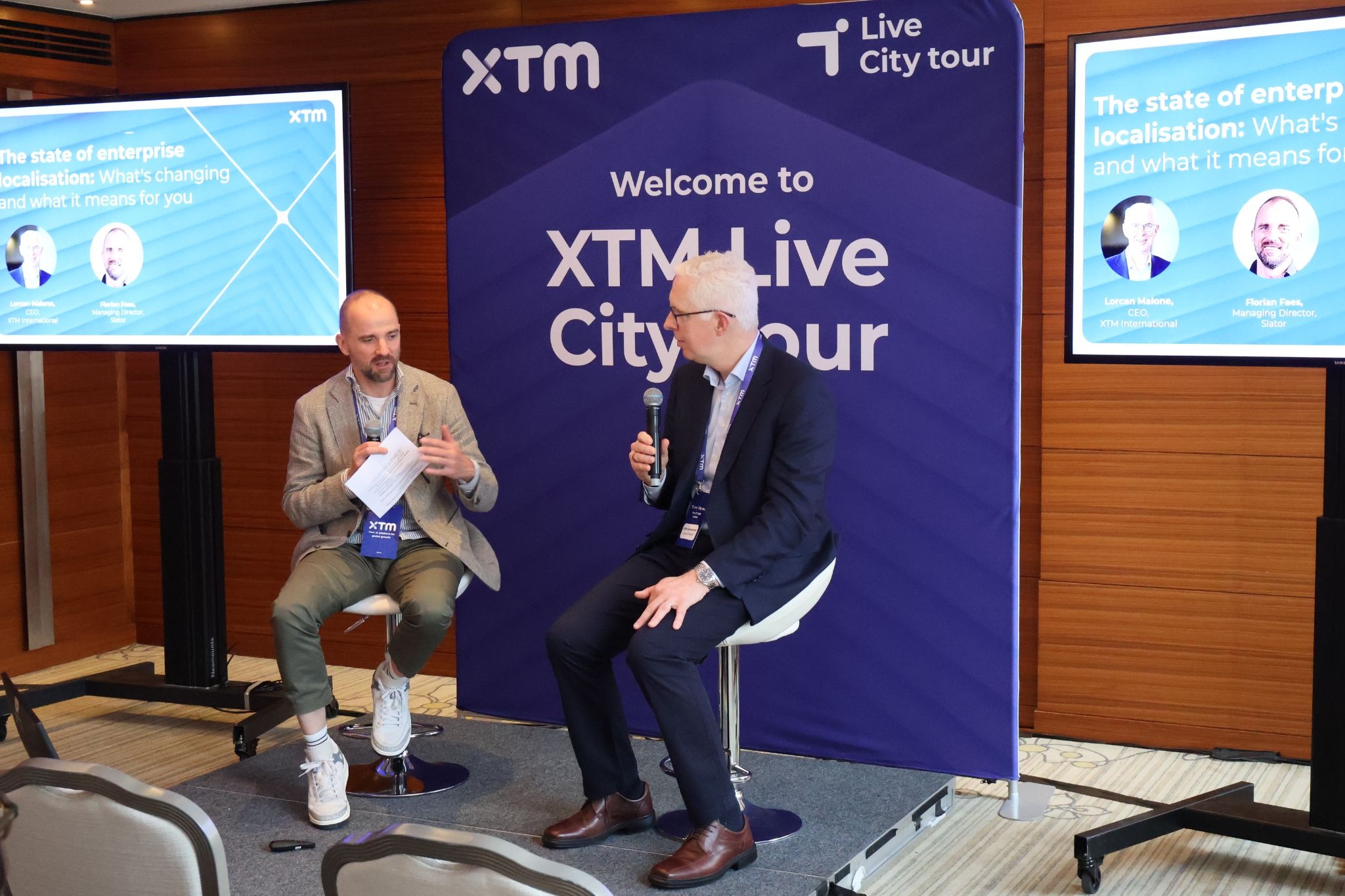
Slator is now using the term "language technology platform" (LTP) for what the industry used to call a TMS. The opening conversation between Lorcan and Florian sat squarely on that shift: the TMS isn't going away, but the job is being done very differently.
Enterprise-grade is the differentiator
The work is moving from top-down workflow management to AI-driven orchestration, where content routing is decided by risk and context, with humans inserted by exception rather than by default. Lorcan's framing: anyone can "vibe-code" a translation prototype with Claude Code or ChatGPT, but enterprise software is a different-scale problem. Complexity, integrations, scalability, security, traceability, and auditability. XTM customers process hundreds of millions of words; that doesn't happen by accident.
MCP, the Model Context Protocol, came up in the fireside. XTM launched its MCP layer days before the event, with significant implications: a marketer in Slack, Teams, or Asana can request a translation in natural language and have XTM orchestrate routing, quality control, and human review in the background. Franziska from IQVIA confirmed they’ve already operationalized MCP across multiple internal systems.
MCP, in production
XTM launched its Model Context Protocol (MCP) layer days before the event. The shift it enables: someone in Slack, Teams, or Asana asks for a translation in natural language, and XTM handles routing, quality, and review behind the scenes. Franziska from IQVIA said her team is already running MCP across multiple internal systems.
A few other points from the fireside: vendor neutrality stays core (XTM stays open to every LLM and MT engine); style guides are emerging as a major quality lever, and AI is now helping draft them; and the historical assets (TM, terminology, scoring) are more valuable than ever as the foundation AI sits on top of.
“What a TMS has always needed to do is still the same, but it’s going to be delivered completely differently over the next few years. XTM will almost become invisible.”
— Lorcan Malone, CEO, XTM International
WHAT IT MEANS
For buyers, this changes the evaluation criteria. Speed and quality matter, but so does composability. Can the platform plug into your enterprise orchestration layer (think n8n), expose itself through MCP, and let your teams interact with localization from inside the tools they already use? For localization leaders, MCP is the lever to extend curated, governed translation to the long tail of content that currently bypasses you and ends up in ChatGPT.
2. Scaling globally with AI localization
Veronica Di Martino, Industry Expert & Localization Leader
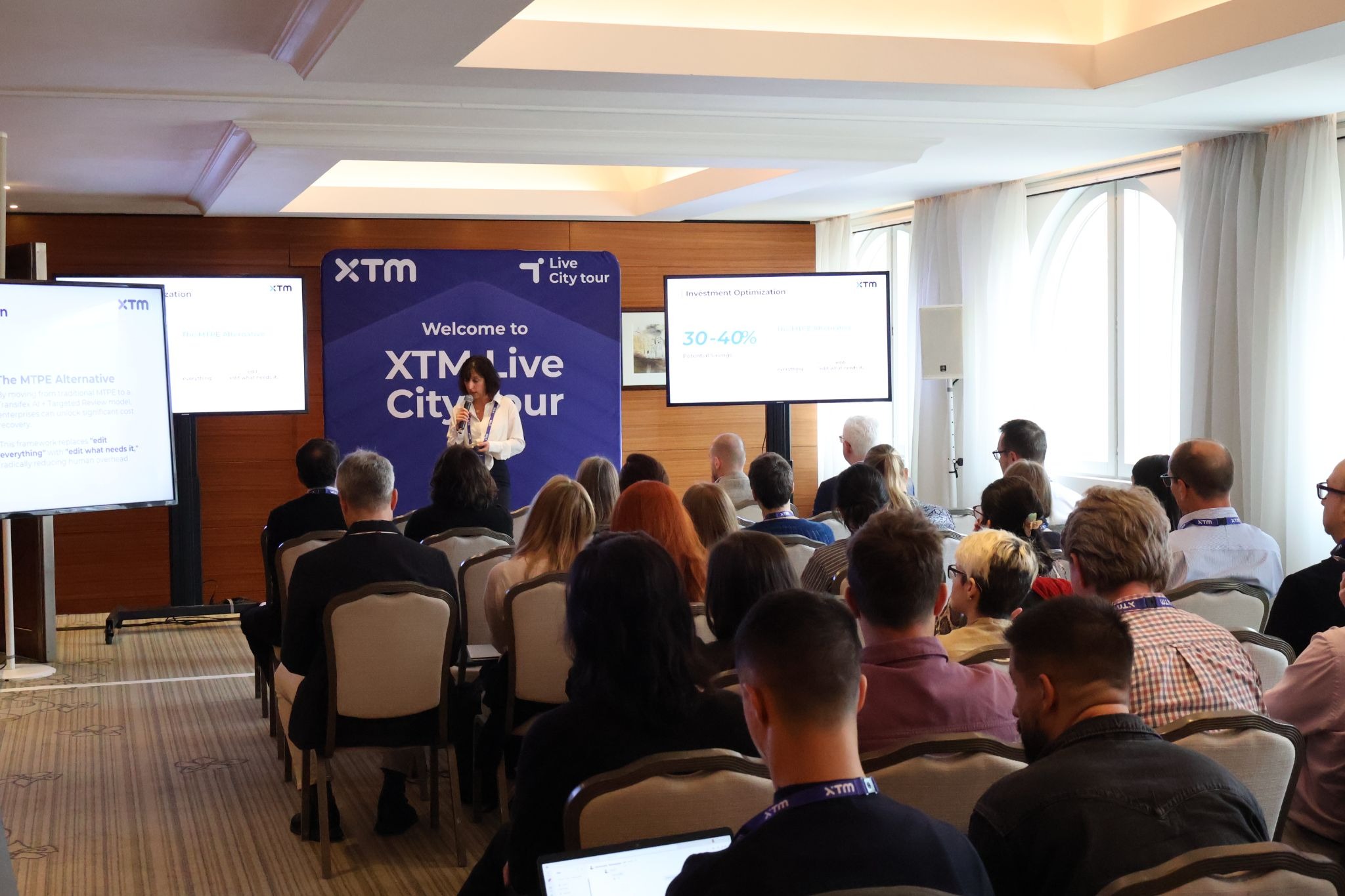
Veronica delivered what may have been the most-quoted talk of the day. Her thesis was disarmingly simple: the biggest challenge for AI isn’t just the model itself, but establishing trust. Trust isn’t automatically granted; it is built gradually through careful measurement, effective governance, and the often overlooked task of strengthening your foundational work.
A TQI-gated pipeline
Veronica walked us through a TQI-gated pipeline she built with the Transifex team. The architecture has four moving parts: content ingestion, real-time quality scoring on AI output, threshold-based routing (publish directly, or pass to a human), and a selective (not universal) human review step. High-risk and high-visibility content (legal, payments, new feature flows) always gets a human, regardless of score.
The headline metric: a 70% reduction in human review overhead. The headline she wanted us to remember: linguists didn’t disappear. They moved upstream, away from reviewing “click here” and toward brand voice, cultural nuance, risk evaluation, and the edge cases where machines still struggle. She called it the evolution from linguist to language strategist.
Foundations first
Equally important was how she got there. They didn’t flip AI on everywhere at once. They started with low-risk content, kept full human-in-the-loop during enablement, audited TMs and style guides exhaustively, and calibrated thresholds against their own data, not the defaults. She also flagged a moment where TQI caught an inconsistency between formal and informal Dutch that had crept in through years of vendor changes. AI surfaced the problem; humans fixed it. That’s the loop.
“AI is a mirror. It magnifies us. If your TM is a mess, AI will make translations messier faster. If your style guides are inconsistent, your AI output will be inconsistently wrong at scale.”
“The pipeline is intelligent because it knows what it doesn’t know. Let AI handle the volume. Reroute uncertainty to humans.”
— Veronica Di Martino, Industry Expert & Localization Leader
WHAT IT MEANS
This operational blueprint is what many teams seek, yet few articulate so clearly. The 70% figure is impactful, but the more applicable insight is the model: break down the job into tasks, determine whether AI or a human is better suited for each, route them accordingly, and reallocate the saved hours to human work that genuinely advances brand and revenue. Veronica’s perspective, viewing AI as a mirror reflecting operational maturity, is the most valuable principle to adopt.
3. Fireside: PeopleCert's localization journey alongside XTM
Marina Petritsi, Head of Localization, PeopleCert, and Evangelos Pappas, Localization Lead, PeopleCert, with Iro Anna, XTM International
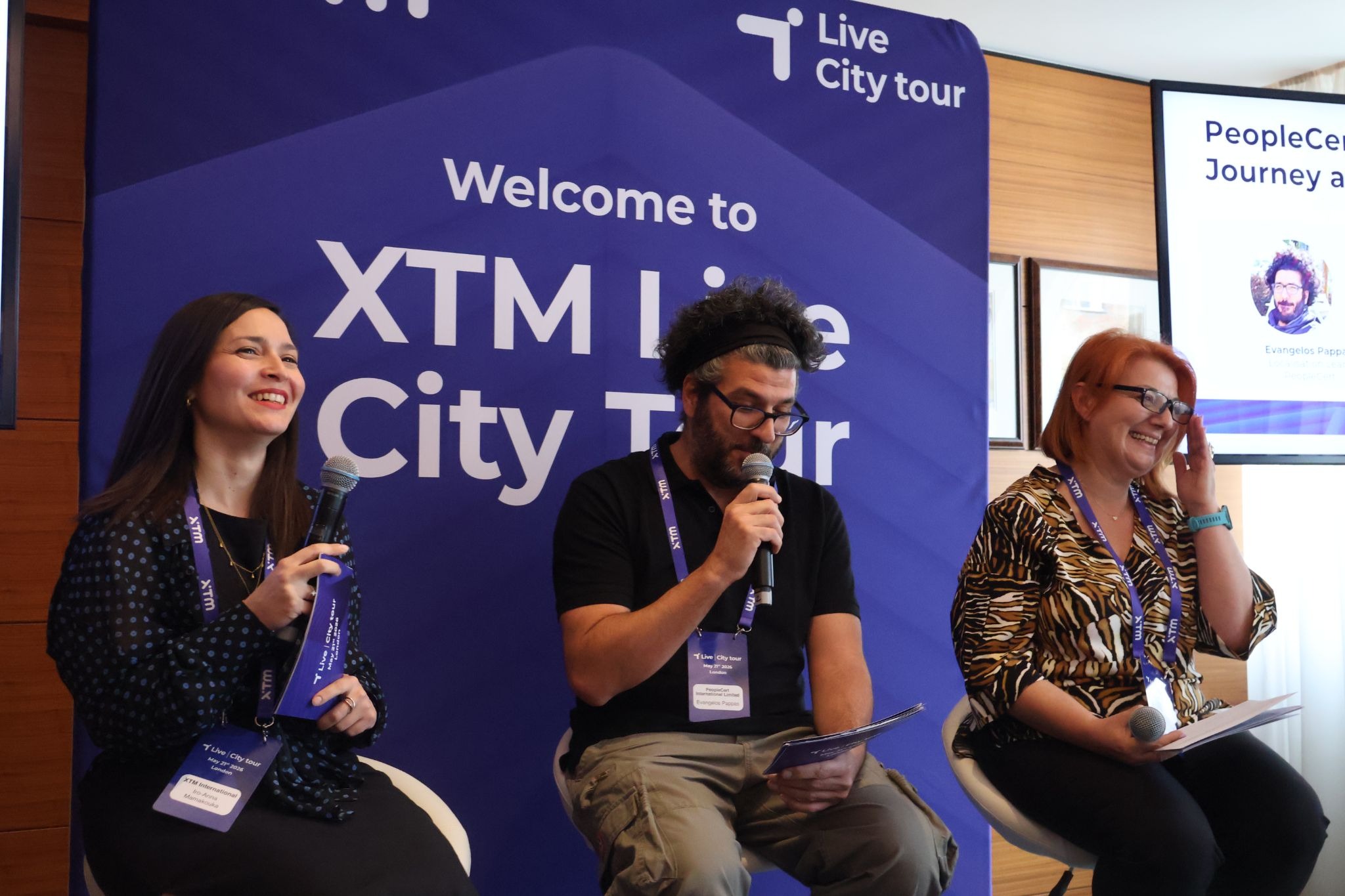
PeopleCert, Greece’s first unicorn and the global certification body behind ITIL, PRINCE2, DevOps Institute, and others, serves millions of learners in ~200 countries across eight core languages. Their content has zero tolerance for ambiguity: exam questions and training material directly affect candidate results and careers. This fireside was the practitioner’s view of what AI-assisted localization looks like when it actually has to work.
AI and quality as non-negotiable
Pre-XTM-AI, the program looked standard: XTM as the TMS, third-party MT integrations, a capable team, but a lot of manual coordination across systems. It worked, but it was strained by rising volume, more languages, and unpredictable post-editing effort. As Evangelos put it: not one dramatic breaking point, but a growing realisation that the operating model wouldn’t scale to the quality bar their learners deserve.
The shift began when XTM AI capabilities, particularly the Translation Quality Index (TQI), moved from feature to foundation. PeopleCert configured the pipeline per language and content type rather than applying a blanket approach. The team’s philosophy on AI was characteristically direct: “We go all in, or we go home.” But quality was non-negotiable.
Partnership as part of the product
What made it work wasn't only the software. Marina and Evangelos pointed to the partnership: the TAM (Iñaki), the CS team flying to Athens, the responsiveness when something needed fixing. That trust is what made it possible to push AI into content that can't afford to be wrong.
4. Beyond translation: Inside the globalization platform of tomorrow
Sara Basile, Director of Platform Product Management, XTM International
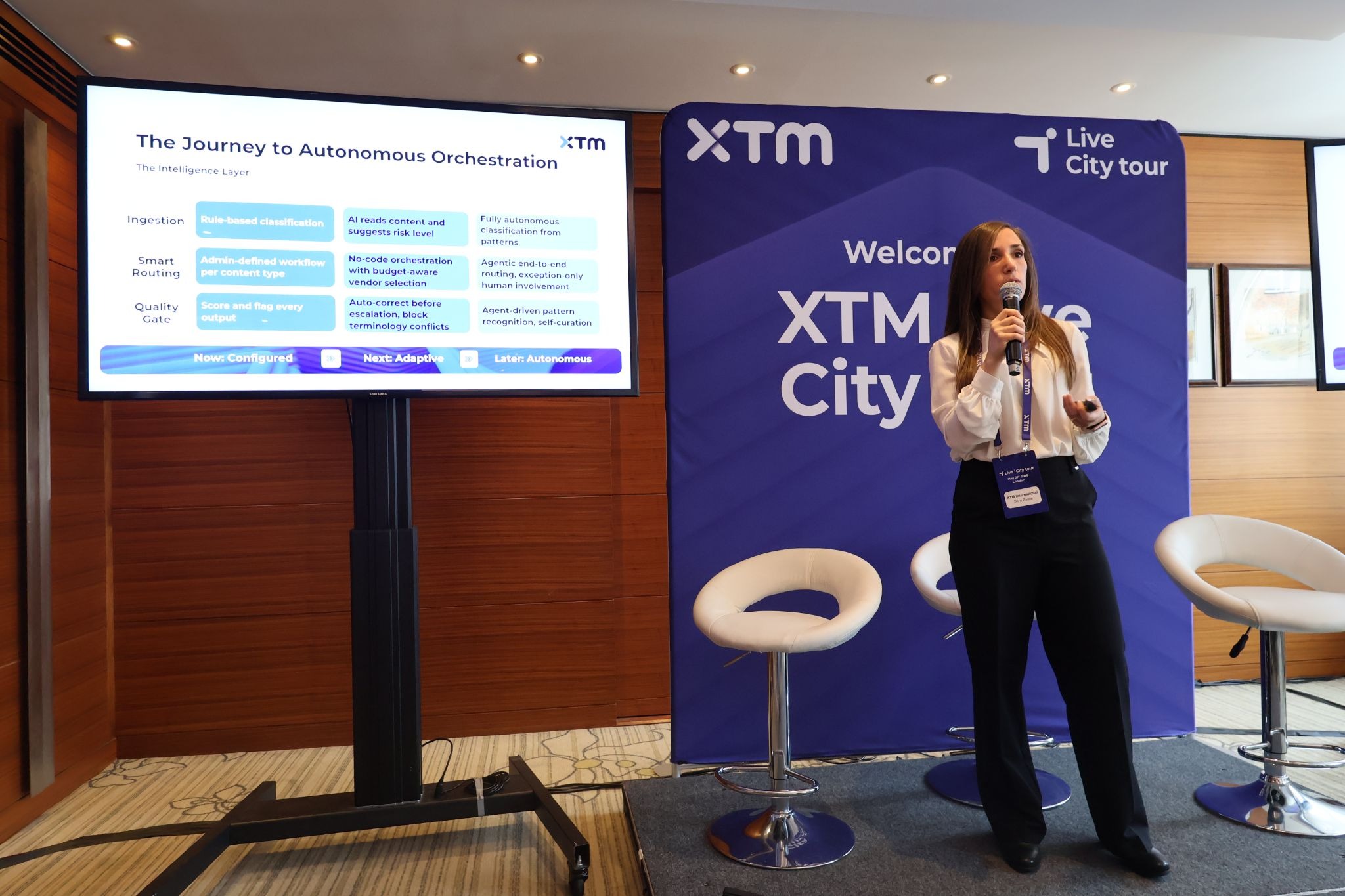
Sara closed the formal sessions with the most product-forward session of the day: a look at the platform XTM is actively building, why we think the traditional speed-quality-cost trade-off is no longer the right frame, and a first public look at XTM Go.
Three layers: knowledge, intelligence, experience
As content volume is exploding (AI-generated content, faster product cycles, more regulatory requirements), and the operating model for getting it translated at quality, on time, and at cost has barely changed in 10 to 15 years. Stitching products together with integrations isn’t the answer. A platform with intelligence built-in is.
Sara walked through the three-layer model that frames the XTM Intelligence roadmap:
- Knowledge layer: TM, terminology, style preferences. The linguistic intelligence built up over years, now shared across every workflow on the platform.
- Intelligence layer: smart ingestion that classifies risk and content type, smart routing that picks the right workflow, an AI engine control plane where customers bring their own LLM/MT keys (Azure OpenAI, AWS Bedrock, Vertex), and quality prediction (Intelligence Core).
- Experience layer: role-specific surfaces. A project manager wants management-by-exception. A linguist wants a distraction-free interface. A developer wants APIs. An agent wants MCP. Different doors into the same platform.
Configured today, autonomous tomorrow
XTM Go is the visible new surface: a headless triage capability that analyses incoming content, classifies intent and risk, suggests the right workflow, and lets users override if they want to. The user keeps control, but the default is intelligence, not configuration. Coupled with proactive sentinel alerts in Teams or Slack (“quality is dropping on this project; here’s the recommended next action”), the platform starts to come to you rather than the other way around.
The trajectory Sara laid out: configured today, adaptive tomorrow, autonomous over time. Each layer evolves on this curve. The AI engine and quality evaluation are already configured and moving to adaptive; XTM Go starts configured and will become self-curating as it learns from performance data.
“Historically, a project manager defined the template, the rules, the guardrails. We think the platform should be making that decision, and your role shifts from configuring workflows to defining and monitoring guardrails.”
— Sara Basile, Director of Platform Product Management, XTM International
WHAT IT MEANS
This is the most concrete statement yet of where the role of the localization leader is heading. Not extinction, elevation. The work moves from operating the machinery to designing the policy the machinery follows. The composable, open-platform direction (bring-your-own-LLM, MCP-first, headless capabilities) is also the right defensive posture against organizations that might otherwise build point solutions internally and lose the economies of scale that a platform provides.
Three things to take forward
→ Enterprise-grade is the new differentiator. Anyone can prototype a translator. Almost no one can deliver hundreds of millions of words with the traceability, security, and orchestration enterprises require. Lead with that when you’re building the business case internally.
→ Foundations are the unlock. Every customer story in the room, Veronica’s and PeopleCert’s, started with the same step: audit your TMs, sharpen your style guides, calibrate your thresholds. AI magnifies whatever it inherits. Spend the time.
→ The human stays, but moves. Fewer linguists post-editing “click here.” More language strategists shaping brand, voice, risk, and cultural nuance across markets. That’s a more interesting job, and it’s the one the data says is durable.
Closing
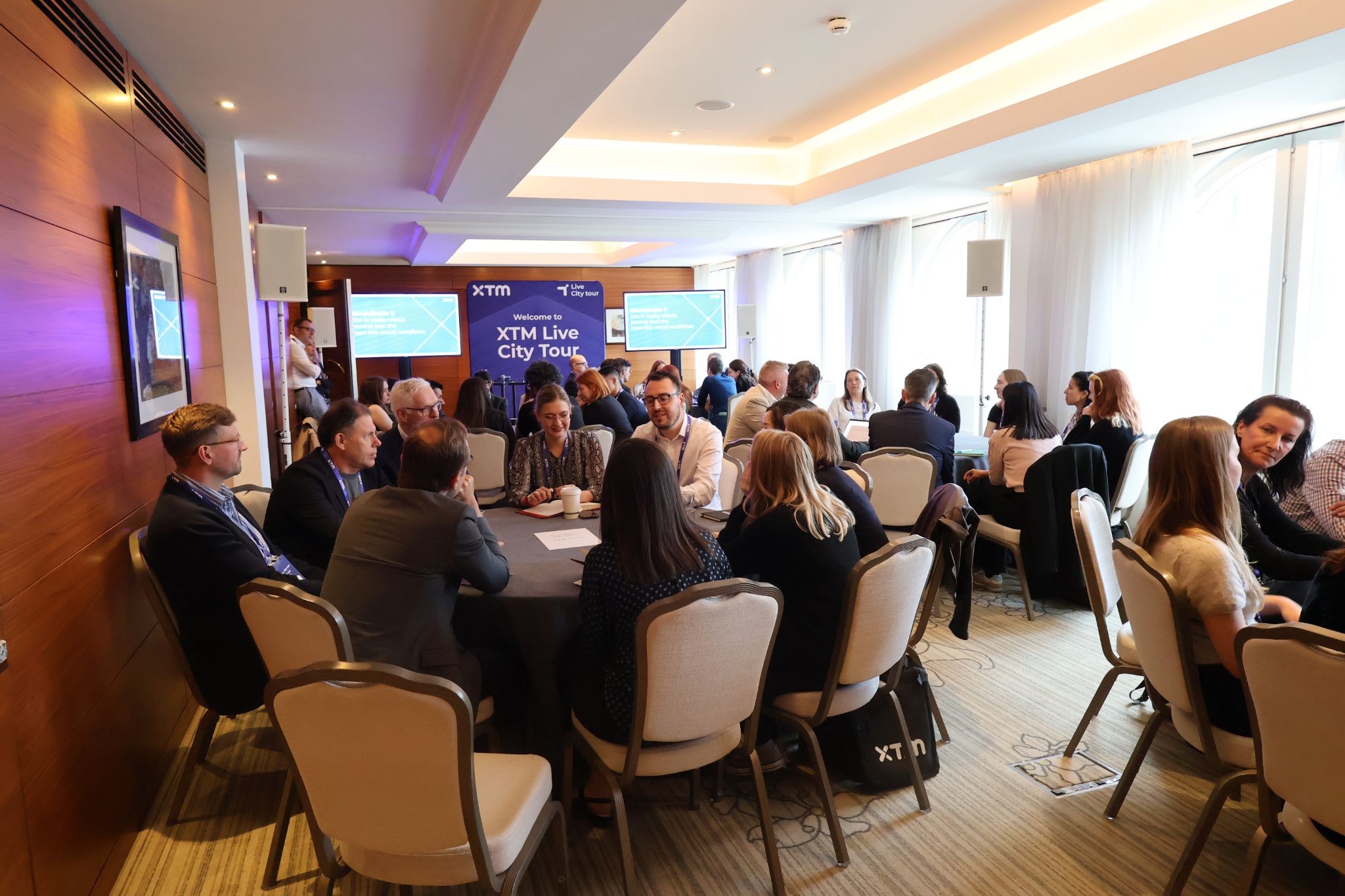
The afternoon shifted into round tables on AI and connectivity, the kind of conversations that don’t make it into a blog post but make a day like this worth flying in for. Thank you to every customer, partner, prospect, and team member who joined us in London. Next stop: Dublin.

Subscribe for More
Lorem ipsum dolor sit amet, consectetur adipiscing elit, sed do eiusmod tempor incididunt ut labore et dolore magna aliqua. Ut enim ad minim veniam, quis nostru.