



.png?width=512&height=512&name=FlowFit_Flavicon%20(1).png)







For our second episode of XTM Talks, we hosted three guests for a frank conversation about AI. XTM COO Alex Zekakis leads the discussion with: Lorcan Malone, CEO of XTM, Dave O’Flanagan, Chairman of the Board at XTM, former CEO of Sitecore and founder of Boxever, Maya Toutountzi, Director of AI Product Management at XTM.
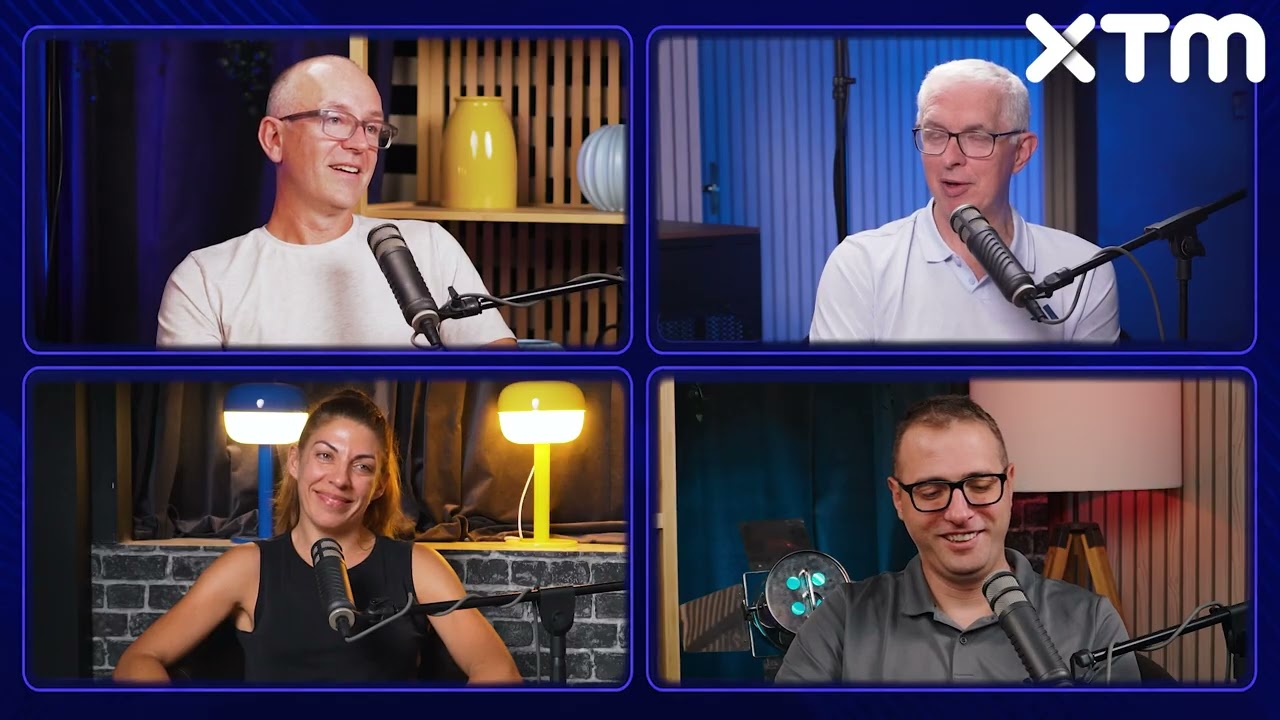
Titled From quick AI builds to agentic workflows, where localization is heading, the episode explores three ways AI is changing localization. Building software and translations is now fast and cheap. Localization is shifting from a production issue to a governance issue. And work is becoming more agentic, with AI agents handling routine workflows so people can focus where their judgment matters most.
What you'll learn from this episode
- Why judgment now matters more than output in product development
- Where DIY AI translation breaks down for enterprise and regulated content
- What XTM IQ is, and how it uses context and TQI to make AI translation trustworthy
- Why localization is shifting from a production issue to a governance issue
- What the panel expects from agentic work and AI-generated language assets over the next year
How AI has changed the way products get built
Two years ago a new feature took months to ship. Lorcan Malone says you would be embarrassed to put up a three-year roadmap today. At XTM, the detailed plan now covers the next couple of months, and anything past six months is a sketch.
Dave O’Flanagan has watched the same shift from the boardroom. When code was expensive, product teams spent their days guarding engineering time. Now that costs are reduced, their value comes from picking the right problems to solve.
Maya Toutountzi explains that the way XTM designs features has changed too. A feature used to start as a screen, with an API bolted on later. Now they plan from day one for people in the interface and for the AI agents working on their behalf.
Can you build your own AI translation tool?
Yes, and for around $2,000. The panel is honest about it. For low-risk content, a homemade AI translation tool might serve you well.
The picture changes once the content matters to the business. Lorcan Malone points out that anything that has to stay consistent and on brand needs guardrails around it. Some of XTM’s customers work in heavily regulated industries, where a homemade tool simply won’t hold up. Dave puts a number on the gap.
Maya Toutountzi adds that closing that gap is where the money goes. The build cost is the smallest number in the equation. The expensive moment comes later, when a wrong translation has to be fixed or something reaches production that never should have.
Then there’s the question of who answers for those mistakes, and for large enterprises it is already a live one. At XTM Live in San Francisco, customers described shadow localization, where teams quietly run their own AI translation outside the central localization team. Lorcan Malone says those customers were clear on one point: when a team goes its own way, the accountability goes with it.
What is XTM IQ?
XTM IQ is the AI orchestration and intelligence layer of the XTM platform. It analyzes content risk, improves your context with AI, learns from every human correction, and decides where human oversight is needed.
Maya Toutountzi is clear that the language model inside it can be swapped at any time. The value sits in the context and control around it.
That context is built from the material your team has been creating for years:
-
Translation memory (TM), with every approved translation reused automatically
-
Terminology and glossaries
-
Style guides
-
The corrections your linguists make every day
XTM IQ also uses AI to keep improving that context, so the system gets sharper the longer you use it. TQI, XTM’s translation quality score, rates every output before it ships and shows where a linguist needs to step in.
Dave O’Flanagan calls this a compounding data asset. Every human decision teaches XTM IQ what "good" looks like for your business.
Why localization is becoming a governance issue
Dave O’Flanagan admits that when he first looked at the industry, he expected LLMs to wipe localization out. Time with customers in life sciences and heavy industry changed his mind. In those sectors one wrong word can turn into a regulatory problem, and a hallucination is simply unacceptable.
Lorcan Malone sums up where that leaves the industry.
In practice, the level of oversight follows the risk. An internal update can go through instant AI translation with light checks, while a safety label waits for a qualified reviewer before it ships.
XTM Go is how XTM puts that into practice across the whole company. Every team gets one place to request translation, and XTM Go routes each request to the workflow that fits its risk, from instant AI translation to full human review. The localization team keeps visibility and control over all of it, so “good enough” is only ever used where it is the right call.
What the next 12 months could look like
To close, Alex Zekakis asks each guest what will be true about AI and localization a year from now.
- Work becomes more agentic. Dave O’Flanagan expects a large share of enterprise software use to be agentic. Instead of configuring 50 forms and plugins, you ask an agent to run the workflow and report back.
- Workflows become autonomous. Maya Toutountzi already sees early adopters letting AI make decisions, not just suggestions. She expects the rest of the market to follow.
- Language assets and roles change. Lorcan Malone expects AI to create and improve translation memory, terminology and glossaries. He sees translators spending more time shaping the systems around the work, much like software engineers today.
Listen to the full episode
Want to hear the full conversation on governance, quality and the future of AI in localization? Watch the full episode on YouTube or listen to it on Spotify, along with Episode 1 of our XTM Talks series.

Subscribe for More
Lorem ipsum dolor sit amet, consectetur adipiscing elit, sed do eiusmod tempor incididunt ut labore et dolore magna aliqua. Ut enim ad minim veniam, quis nostru.