




.png?width=512&height=512&name=FlowFit_Flavicon%20(1).png)







What XTM's Lorcan Malone and eBay's Marco Rotelli discussed on stage at SlatorCon San Francisco
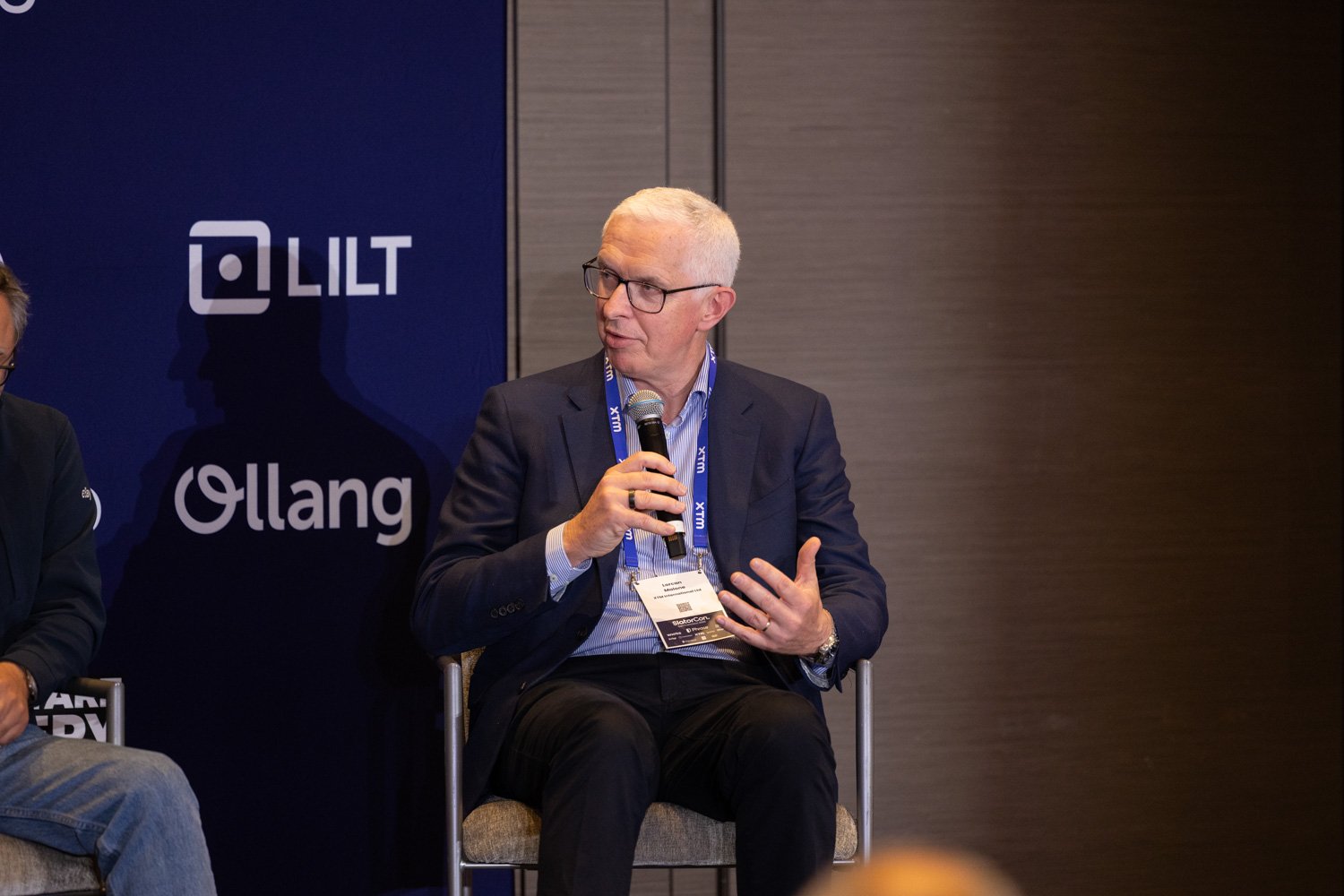
XTM joined SlatorCon San Francisco on September 3rd for a panel on a question more localization teams are sitting with every quarter: how do you get the speed AI promises without quietly signing up for a compliance problem? CEO Lorcan Malone was joined on stage by Marco Rotelli, Senior Product Manager at eBay, in a conversation moderated by Silvia Terribile of Slator, titled Balancing AI, Risk and Compliance in Localization. Here's what stood out from the conversation.
.jpg?width=1500&height=1000&name=XTM%20Panel%20(1).jpg)
From "is it right" to "can we trust it"
For years, the risk question in localization was simple: did we translate this correctly? Lorcan Malone's opening point was that AI has quietly swapped that question for a harder one: can we trust the process that produced this, not just the words themselves. That reframes localization from a production problem into a governance problem, and it matters because AI can cut the cost and time of multilingual content dramatically, but only if the process around it is controlled. Left unmanaged, a company can automate its way into a compliance problem without ever noticing the shift.
Worth knowing In a survey of nearly 2,000 organizations, 51% of those using AI said it had already caused at least one negative consequence for their business, with almost a third pointing to the AI simply getting something wrong.
Marco Rotelli brought the eBay version of the same problem. The company runs two very different content streams: internal content, which stays fully localized and governed, and the flood of user-generated content across eBay's 190-plus markets, which leans on machine translation with human review reserved for where the risk actually warrants it. To make that split work at scale, eBay has been investing in what Marco Rotelli called AI-as-judge: models that evaluate and even rephrase translations before a human ever needs to look at them. That frees up linguists to spend their time on the genuinely complex calls rather than the routine ones.
Lorcan Malone connected that back to something XTM has been building toward directly. The idea is that content gets read and weighed for risk before anyone has to configure a workflow around it. That's the same thinking behind the pitch that won the Process Innovation Challenge at LocWorld Dublin earlier this year.
Routine work is handled by AI in minutes. Anything with real compliance or brand stakes escalates automatically to a person, and every decision leaves an audit trail behind it. The system suggests the route, and a person still decides. Nobody is left guessing who owns that call.
Rethinking what quality means for translation
Localization quality has always been judged by a human reader: is it accurate, natural, culturally right, on-brand. That bar hasn't moved, if anything it's higher than it used to be, since audiences have gotten sharper about spotting AI-generated content that feels generic.
Did you know? Gartner found that 49% of U.S. consumers, and 57% of Gen Z and millennials specifically, believe AI-generated content quality is declining, simply because there's so much more of it now.
What's new is the second reader in the room. As AI agents increasingly do the reading, comparing, and even the buying on a customer's behalf, localized content has to satisfy a machine audience too, not just a human one. That doesn't rewrite the fundamentals of quality, but it does add new dimensions to it:
-Can an agent correctly interpret the meaning?
-Is terminology used consistently enough for an agent to trust it across sources?
-Is content structured so an agent can actually find the relevant information?
-And could a mistranslation cause an agent to draw the wrong conclusion, or recommend the wrong product entirely?
Marco Rotelli's numbers gave that some real weight: at eBay, around 20% of AI-translated content still fails quality checks on the way through, some of it for legal or otherwise critical reasons, which is exactly why the review step still exists rather than being automated away. Lorcan Malone's read on the stakes was blunt: a typo might get forgiven, and a clunky sentence might cost you a few conversions. If an AI agent can't interpret the content properly, though, it risks being left out of the comparison entirely, or never making it into consideration in the first place.
.jpg?width=1500&height=1000&name=XTM%20Panel%20(2).jpg)
Putting controls where they actually add value
When asked how to build in the right quality and risk controls without bringing back all the cost and complexity AI was meant to eliminate, Lorcan Malone challenged the question itself. The real mistake isn't having controls, it's applying them uniformly, either to everything or to nothing, instead of focusing them on the content that actually needs them.
He illustrated it with two real, opposite failure modes. A large pharmaceutical customer found that more of its content was bypassing its governed platform than flowing through it. This shadow AI use was completely invisible to the people responsible for managing risk. On the other hand, a global consumer goods customer had the mirror-image problem: almost everything ran through full governed review, including plenty of content that never needed a human touch at all, so the company was paying full price for judgment nobody actually needed. Neither company had actually decided what warranted scrutiny in the first place, which is exactly why one ended up applying none of it and the other applied all of it.
Marco Rotelli raised the efficiency side of that same dynamic from eBay's side: checks and sign-offs are only worth what they cost if people genuinely trust the process behind them. Too much friction and teams route around it. Too little, and complacency creeps in, with people trusting AI's judgment more than they should. His practical advice for other localization leaders: avoid chasing AI simply because it's available, experiment broadly, and only deploy where it's actually proving its value, since AI costs add up faster than people expect.
Looking ahead
Looking 1 to 2 years ahead, both panelists agreed on a similar shift. The old risk, whether AI can even produce fluent, accurate language, is fading. It increasingly can, in more languages and at lower cost every year. The new risk is harder to solve: whether AI can be trusted to decide, entirely on its own, what's safe to publish without a person checking it first.
Marco Rotelli flagged a subtler risk further out: as more of the content online is itself AI-generated, models increasingly learn from AI output rather than human writing, which risks a kind of flattening, where everything starts to sound the same. His more optimistic view is that human creativity will keep this from becoming a real problem in localization, the same way it has in other creative industries,
Lorcan Malone's framing was that this doesn't shrink the human role in localization, it moves it. For high-stakes, culturally nuanced, or premium brand content, expert human translation isn't going anywhere. For the much larger volume of everyday enterprise content, the shift is from operating the machinery by hand to defining the strategy, policy, and context that machinery follows: less production, more judgment.
Three takeaways worth remembering
A few points from the panel that are worth keeping in mind going forward.
→ Rules work better than bans. The risk was never people using AI. It's leaving the decision about what's safe to publish up to whoever happens to be doing the work, without anyone else checking it.
→ Content now has two readers. Human quality standards haven't gone away, but content increasingly needs to make sense to an AI agent reading it too. That means being clear enough for a machine to understand correctly is becoming just as important as sounding natural to a person.
→ Match the level of checking to the content itself. Applying the same level of review to everything, or to nothing, is where cost and risk both quietly build up. The fix in both directions is the same: deciding, on purpose, what actually needs a closer look.

Subscribe for More
Lorem ipsum dolor sit amet, consectetur adipiscing elit, sed do eiusmod tempor incididunt ut labore et dolore magna aliqua. Ut enim ad minim veniam, quis nostru.