




.png?width=512&height=512&name=FlowFit_Flavicon%20(1).png)







Most teams know instructional video matters. Finding the time and resources to do it well is another story. Let alone localizing those videos for every market they support, only to update them again every time the product changes. It's a cycle nobody wants to get into, and understandably so.
But the true impact of that decision tends to get overlooked. And once you see the data, it's hard to unsee.
What actually determines whether customers adopt your product
83% of people prefer learning from video over any other format, more than text, manuals, and webinars combined.
"Two-thirds watch at least one instructional video every week. Nobody asked them to. They went looking."
— TechSmith Video Viewer Study, 2024
When someone searches for a how-to after buying a product, they're trying to get something to work. Whether they succeed shapes everything that follows: confidence, adoption, loyalty.
The myth of the short video
There's a widely held assumption worth questioning here. TechSmith found that when content is directly relevant to something a person needs to do at work, 67% will watch for over an hour. The variable driving engagement isn't patience — it's whether the content matches what's actually in front of them.
When it doesn't, most people don't ask for help. They quietly disengage. Harvard Business Review found that 81% of customers try to resolve issues themselves before contacting support, and 91% say they would use a self-service resource if it actually met their needs. For instructional video specifically, that means the quality and accessibility of what you publish determines whether customers ever successfully adopt what they bought.
Why customer education drives adoption, retention and LTV
In 2024, Forrester Consulting surveyed 300 customer education decision-makers.
| What companies with structured customer education programs reported | |
|---|---|
| Increase in product adoption | +38.3% |
| Increase in average lifetime value per customer | +35% |
| Decrease in support costs | -15.5% |
| Reported positive return on investment | 96% |
When customers consistently get the help they need to succeed with a product, adoption goes up, support costs come down, and lifetime value grows. These numbers reflect that directly.
And they depend on one thing the data rarely accounts for: whether that content is actually accessible to the customer in front of it.
Language coverage is the biggest gap in video production
CSA Research surveyed 8,709 consumers across 29 countries on how language affects purchasing behavior after the sale. The findings get cited constantly in marketing and localization discussions, but almost never in the context of instructional video, where they arguably matter most.
Most companies produce instructional videos in one or two languages and treat everything else as a budget decision.
Here's what that decision costs:
Retention: 74% of customers are more likely to keep purchasing from a brand that supports them in their language after the sale
Repurchase: 75% are more likely to buy again when post-sale support is available in their native language
Reach:40% won't engage with foreign-language content at all — meaning that investment simply doesn't reach them
Adoption: the Forrester gains in adoption and lifetime value stay unrealised in every market where language coverage falls short
Why traditional video production wasn't built for language scale
Most companies haven't solved the multilingual video problem for a straightforward reason: the economics made it genuinely prohibitive.
Localizing one video into twenty languages meant twenty voiceover sessions, twenty editing cycles, twenty rounds of review. When the product updated, teams started again from scratch. When the product updated, teams started again from scratch. Coverage decisions got made by budget, not by customer need — and the gap stayed.
What's changed: automating product education videos
XTM's Video Creation Cloud generates narrated, subtitled video directly from your existing documentation—DITA, XML, Markdown, in whatever format your team already maintains. No studio. No voiceover sessions. No post-production cycle.
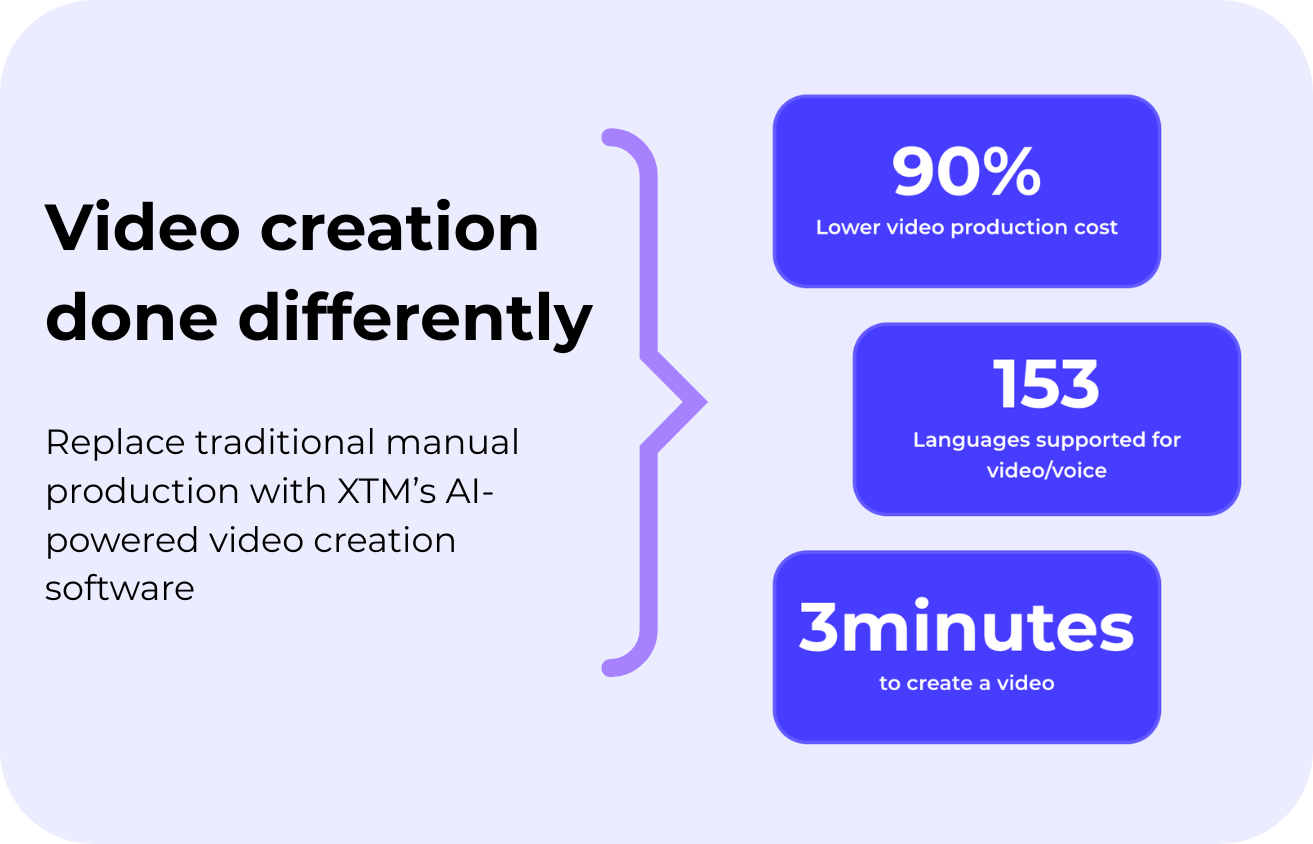
When the source documentation updates, the video updates with it. When you need a new language, you add it — without touching the original. The result is a multilingual video library that scales without rebuilding from scratch, maintained by the same workflow that keeps your docs up to date.
Here's how it works:
Why multilingual instructional video is worth prioritising now
The companies closing this gap aren't necessarily the ones with the biggest budgets. They're the ones that stopped treating language coverage as a secondary decision.
When instructional video is accessible to every customer in every market, the Forrester numbers stop being a benchmark and become a realistic outcome. That's where the return on this investment actually lives.
Want to see how XTM's award-winning AI platform can help? Let's chat

Subscribe for More
Join our newsletter for real-world guidance on localisation strategy, AI-powered translation, and managing multilingual content at scale.