




.png?width=512&height=512&name=FlowFit_Flavicon%20(1).png)








Summary
- Customer: HubSpot, a customer relationship management platform serving more than 300,000 customers in over 135 countries.
- Challenge: The localisation team forecasted 30% annual growth in content volume but saw volume grow by over 65%, putting localisation on a cost curve that multiplied every year.
- Solution: HubSpot adopted XTM IQ, the AI engine inside XTM's AI Globalisation Platform. XTM IQ evaluates every AI translation against HubSpot's quality requirements, so content that meets the bar goes live with confidence, and low-scoring translations are routed to review.
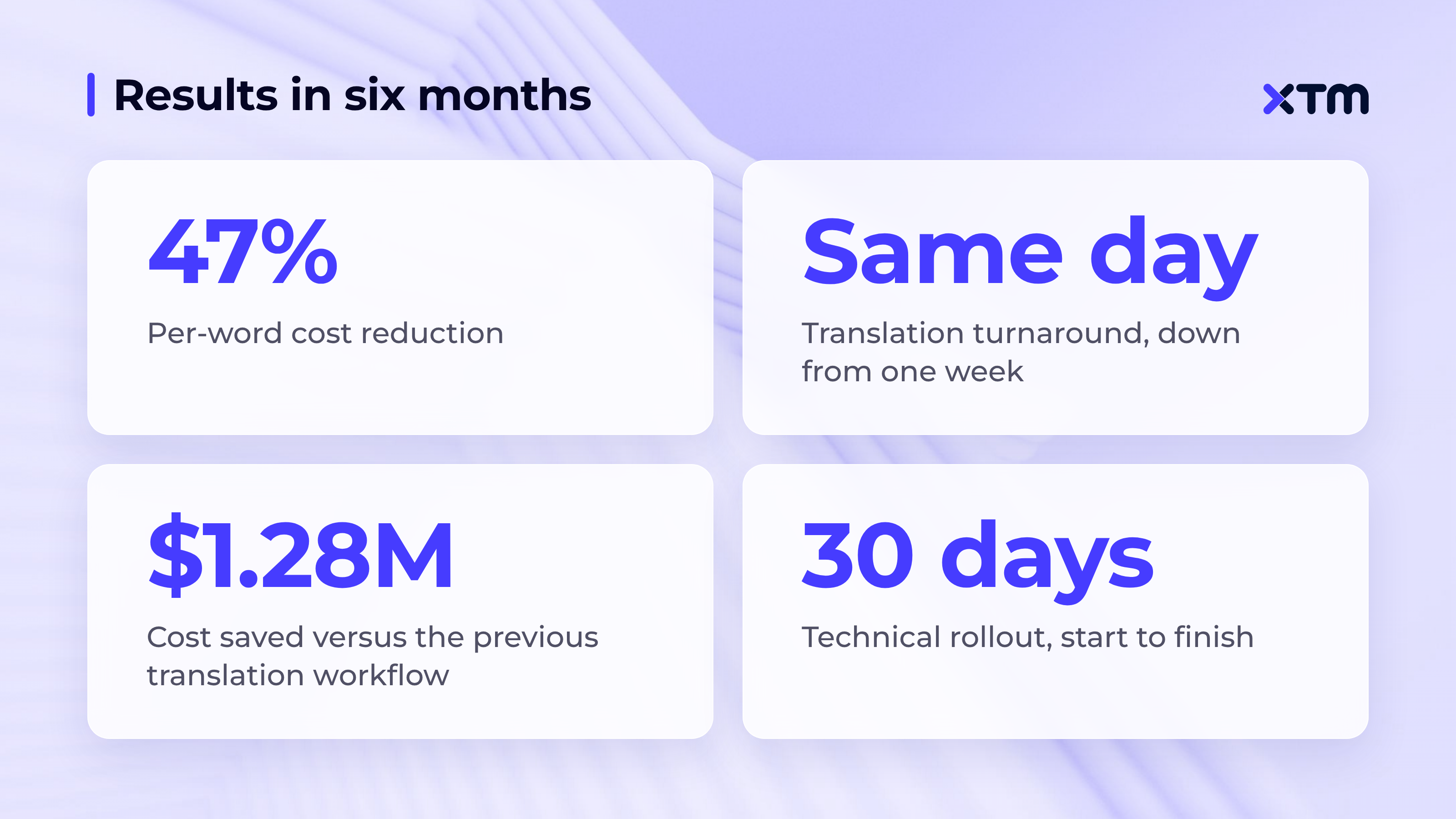
- Result: In six months, HubSpot delivered 65% more multilingual content at 26% lower cost, saving over $500,000 year over year. Compared with the team's previous workflow, it saved $1.28 million and cut cost per word by nearly half.
About HubSpot
HubSpot sells customer relationship management software to more than 300,000 customers in over 135 countries and across 17 different languages and locales.
HubSpot releases its product continuously. Changes go live dozens of times a day across global time zones, and hundreds of developers push code daily. Every one of those changes has to reach users in all languages without anyone filing a translation request.
The team forecasted 30% content growth and received 65%
For over a decade, HubSpot ran product localisation through a largely outsourced model of human translation and human review. The quality was consistently high. The cost was the problem.
The team had projected 30% annual content growth. Actual volume grew by over 65%. Each new feature, language, and release added to the total, and the cost curve showed no sign of levelling off.
"It was born out of the realisation that if we continue with the very traditional workflow, our costs will multiply every single year."
-Dierk Runne, Senior Manager, Localisation & Systems, HubSpot
HubSpot set a hard condition: no quality loss
HubSpot first tried machine translation with human post-editing, a common approach in which a machine produces the first draft and a human corrects it. Costs came down. So did quality.
"The quality loss that we suffered was pretty severe. And we also had a significant amount of content where the MT simply was not good enough, notably with handling tags and very long segments."
-Dierk Runne, Senior Manager, Localisation & Systems, HubSpot
Traditional MT engines handled code tags and very long text segments poorly, forcing the team to add more resources to handle those errors, which cancelled out the savings the model was meant to produce. In the worst cases, flawed translations made it into product builds and delayed releases.
The team did not need cheaper translation. They needed a way to absorb 65% content growth without losing quality and without adding reviewers to catch what the machine got wrong.
XTM IQ scores every translation and orchestrates what happens next
HubSpot adopted XTM IQ, the AI engine inside XTM's AI Globalisation Platform. What made the difference was not translation speed alone. It was XTM IQ's ability to automatically score every AI translation against HubSpot's quality requirements, using thresholds the team sets for each language.
XTM IQ then uses that score to orchestrate the next step. Content that meets or exceeds the threshold is published automatically, bypassing human review. Translations that score below it are flagged with a clear remediation path, so the team can focus on the content that needs attention.
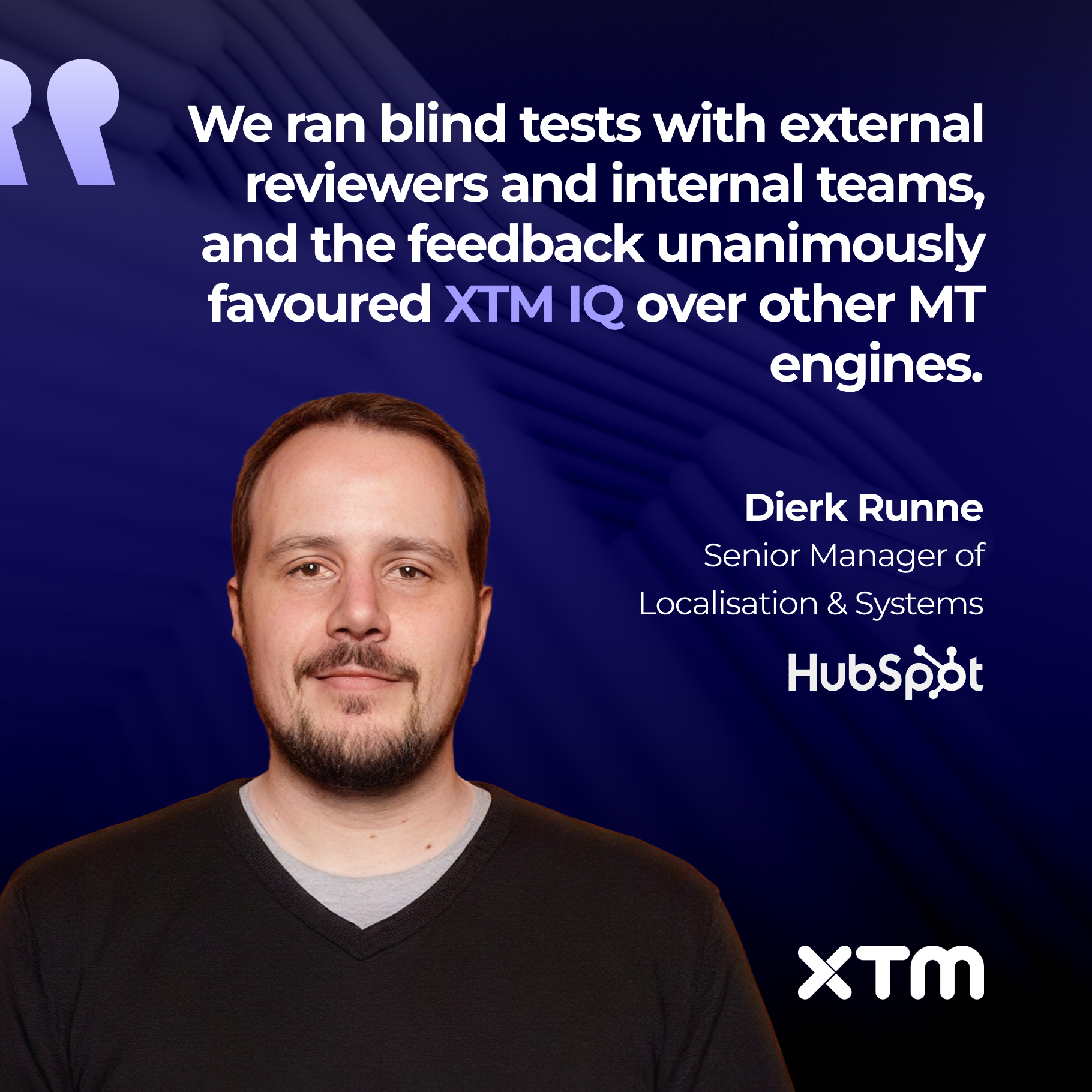
HubSpot tested this before committing to it. The team ran blind comparison tests with external reviewers and with internal teams, putting XTM IQ against the machine translation engines it had already tried.
The technical rollout took just 30 days, and XTM IQ was deployed across HubSpot's core interface languages in February 2026.
The AI engine plugged into a pipeline HubSpot had run for more than 10 years
Adopting XTM IQ required no architectural changes. The engine plugged directly into the continuous localisation pipeline HubSpot had already been running through XTM Transifex for more than 10 years.
With a system designed around continuous integration, that pipeline runs 24 hours a day with no project managers, no manual job creation, and no work packages to allocate. Developers push code and translations follow.
"With changes going live dozens of times a day across global time zones, continuous localisation is an absolute must for us. XTM Transifex's ability to forego manual project management, avoid micromanaging work packages, and just run on a continuous translation queue is what makes the whole system self-running."
-Dierk Runne, Senior Manager, Localisation & Systems, HubSpot
Quality-based AI orchestration only produces savings when there is a pipeline beneath it that can act on every decision without manual steps. HubSpot already had one.
Translation turnaround fell from one week to the same day
The financial result is the headline. The operational result changed how HubSpot's product teams work.
- From one week to same day. Product teams used to factor in up to a week to receive translations. They now ship translated updates on the same day.
- 83% fewer priority requests. Initial translations now arrive almost instantly, so product teams rarely need to ask for fast-track turnaround.
- 47% publish-ready output. Nearly half of all reviewed translations were shipped to production with zero human edits.
- $1.28 million in cost avoided. Processing the same volume of content through HubSpot’s previous workflow would have cost $1.28 million more. With XTM IQ, cost per word fell by nearly half.
Localisation stopped being something HubSpot's product teams planned around and became something that happened alongside the release. This quality-driven AI orchestration removed a massive manual review bottleneck. Baseline quality remained so consistently high that 59% of all localised content needed only minimal adjustments, with 47% requiring no edits at all.
Why HubSpot chose XTM
Most AI localisation projects ask a customer to rebuild their pipeline in exchange for a saving. HubSpot did not rebuild anything. HubSpot kept the pipeline it had spent more than 10 years refining and changed the engine running inside it.
In live production across 18.7 million words, XTM IQ achieved a 92% linguistic retention rate, meaning more than 9 out of 10 AI-generated words were accepted by human reviewers without a change.
That is what made a 26% reduction in spend possible in the same six months that content volume grew 65%, without the quality loss that ended HubSpot's earlier attempt at machine translation.
But for HubSpot, the value goes far beyond bottom-line savings. By shipping high-quality translations the same day a feature is ready, the team can get new products to international users instantly. It effectively turns localisation from an operational cost centre into a powerful engine for global expansion and revenue growth.
For more than 10 years, XTM Transifex has evolved with HubSpot's requirements rather than holding the company back with legacy solutions. That is the difference between a software vendor and a strategic growth partner.
What comes next
Building on the strength of these results, HubSpot is preparing to roll out XTM IQ across nearly 30 more languages, covering additional long-tail use cases. Scaling coverage while reducing complexity.

Questions this story answers
What problem was HubSpot trying to solve?
HubSpot budgeted for 30% annual growth in content volume, yet saw volume grow past 65%. Its outsourced human translation model produced high-quality results but cost more each year, while machine translation with human post-editing lowered costs at the expense of quality.
What is XTM IQ?
XTM IQ, formerly Transifex AI, is the AI engine inside XTM's AI Globalisation Platform. It produces translations and assigns each one an instant quality score, so content above a customer-defined threshold can ship without human review, and content below it is routed to a human.
How long did implementation take?
The technical rollout took around 30 days, with no architectural changes to HubSpot's existing localisation pipeline.
How much did HubSpot save?
In six months, HubSpot cut localisation costs by 26% year over year, saving over $500,000, while content volume grew by over 65%. Because the team was translating far more content than the year before, the full saving is larger: compared with its previous workflow, HubSpot saved $1.28 million and cut its cost per word by nearly half.
Did translation quality drop?
No. HubSpot ran blind comparison tests with external reviewers and internal teams before committing, and the feedback favoured XTM IQ over the machine translation engines HubSpot had previously used. Automated quality scoring routes anything below HubSpot's threshold to a human reviewer.
What is HubSpot doing next?
HubSpot is preparing to roll out XTM IQ across nearly 30 additional languages.
See what automated quality scoring could do to your localisation spend
Talk to XTM about putting XTM IQ to work in the pipeline you already run. Schedule a call with one of our experts.